


Skills We Were Never Taught: Issue 23
Few things are as hopeful as expecting a child. Two people who already believe in each other decide to make something that will outlive every argument they have ever had, and the mind does what minds do with hope: it builds a picture. There is a name, a room, a first morning, and a version of the two of you who are calmer, kinder and more patient than you have ever managed to be. The picture is warm and generous, and it is one of the great pleasures of the whole experience. Nothing in this essay is an argument against it.
But a bubble is only as strong as what it is made of, and this one is made of expectation. For a while it holds. Then the baby arrives, the days take on a rhythm nobody drew, and the bubble settles, as bubbles do. The two of you are left looking at the distance between the picture and an ordinary Tuesday. Most people assume that distance is a matter of logistics. It usually is not. It is the discovery that the fantasy was a picture of a baby and a family, and that it had almost no room in it for the two of you.
That is the parent trap. It is not that you hoped. It is that when real life fails to match the picture, you both go looking for someone to account for the difference. The tired person looks at their partner. The partner looks back. Each quietly concludes that the picture would have arrived if the other had been different, and the two people who painted it together end up arguing over who broke it.
§
It helps to know how real the bubble is. A large study followed 1,433 couples from 21 weeks of pregnancy to 19 months after the birth, and nine in ten began with high relationship satisfaction. For 38.7 per cent it stayed high and steady, and for 51.3 per cent it dipped a little. For the other 10 per cent it began low and dropped a long way, and those couples were more likely to have had doubts about the relationship before the birth, or no clear wish for a child. The researchers’ summary is that most new parents experience their relationship as “robust against the challenges of early parenthood.”
We call the dip the parenthood cliff, and the name overstates it. Across 49 studies, satisfaction does fall on average in the first year, by a small to moderate amount, for mothers and fathers alike, and couples without children drift down too, only by less than half as much. The dip is real, and the dip is ordinary. Neither is a sentence passed on you.
What the evidence describes for most people is closer to a change of purpose. The relationship used to be a place where two people knew each other. Overnight it also becomes a place where a third person is kept alive. That job is real, urgent and exhausting, and it can quietly take over the whole building.
§
This is where the trap closes. It is rarely a fight. It is a slow, loving, sensible slide from being lovers to being co-managers. You become excellent at running a household with a tiny and very demanding client, and good at it in all the ways that get thanked. Who has the baby until three. Did the weight check happen. Is there milk. That is real closeness, and in the first months it is necessary. The trouble starts when it is the only closeness left.
A teammate asks what needs doing. A lover asks how you are, and what you have been thinking about, and wants the answer. A teammate says thank you for the nappy. A lover says I still think you are remarkable. For a stretch, most new parents have the first conversation fifty times a day and the second hardly at all, and because the first is so full of care, nobody notices what has gone missing.
The research does not measure this drift directly, so I offer it as interpretation and not a finding. But one large trial comes close. Couples who took a nine-session coparenting program became better at coordinating and communicating around the baby, and yet at ten months they were less satisfied with their relationship than couples who had not taken it. A follow-up about ten years later looked more encouraging. One trial cannot settle anything. It does suggest that being good at the work of parenting and feeling close as a couple are two separate things, and that building the first does not automatically build the second.
§
Why does it happen to people who love each other? Partly because the picture had no room for you, and partly because of what each of you carries. In the home you grew up in, something happened when someone was overwhelmed. They were held, or fixed, or told to stop, or left alone with it. Studies of first-time mothers suggest that how distress was met in childhood shapes how it is handled now, as a shift in the odds and never as a verdict. So one of you reaches for reassurance and the other offers a solution or goes quiet, and each reads the other’s habit as indifference. One is offering what soothed them as a child. The other is protecting themselves the way they learned to. Neither is a verdict on the relationship. Both are information.
And underneath it, almost always, is a grief with nowhere to go. You miss the old two of you. You miss being someone’s person before you were someone’s parent. It feels disloyal to say so, as though missing it were a vote against the child. It is not. It is the most natural thing in the world, and it is far easier to carry when you say it to each other than when it curdles into a quiet suspicion that your partner has stopped seeing you.
One study of first-time parents, followed from pregnancy to 18 months, found that feeling responded to by your partner generally grew over time, and that people who felt more responded to showed smaller rises in attachment anxiety and avoidance. It was correlational, so it is a thread and not a promise, but it fits what most of us already sense. Being helped is not the same as being noticed.
§
One line needs drawing firmly. Everything here describes ordinary strain between two people who are fundamentally safe with each other. If one of you is frightened, controlled or intimidated, or if either of you is struggling with anxiety or depression that is more than exhaustion, that is not a romance problem and a date night will not solve it. In Australia, 1800RESPECT (1800 737 732) is there at any hour, and PANDA (1300 726 306) supports parents through pregnancy and the early years. Your GP or child health nurse is a good place to start too.
§
So how do you stay lovers when you are also on duty? Not with a grand gesture, and not with a checklist. With a handful of small refusals to let the baby be the only thing you are to each other.
Use each other’s names. Somewhere in the first year, couples start calling each other Mum and Dad, or talking about each other in the third person: go to Daddy, Mummy is tired. It is sweet, and it is a quiet erasure. Say your partner’s name. Be a person to them before you are a role.
Give each other the first hello. When one of you walks in, the baby can wait ten seconds. A look, a kiss, a hand on the back, a real how are you. It tells the baby nothing at all, and it tells your partner they are still the person you came home to.
Touch without a destination. Affection that asks for nothing, that is not on its way anywhere and does not need to be. A hand held on the couch. An arm around a tired back. In the early months, much of wanting each other is simply being touched by someone who is not asking anything of you.
Tell them what you see. You are watching your partner become a parent, and it is often astonishing, so say so. Then say the other thing as well: that you still find them funny and beautiful and interesting, and that you have not forgotten who they are. Being admired as a parent and being wanted as a person are two different gifts, and most people are only receiving the first.
Protect one conversation that is not about the child. Fifteen minutes, a few times a week, with the subject banned. Ask the questions you asked when you were falling for each other. What are you thinking about? What do you want this year? What do you miss? If you are stuck, ask what the two of you used to talk about.
Keep dates small and regular. Not a restaurant you cannot afford and a babysitter you do not yet trust. A walk with the pram, a takeaway eaten slowly after bedtime, phones in another room. The point is not the occasion. It is that your relationship has a time in the week with its name on it.
Say what helps, and what leaves you alone. Most partners are guessing. One sentence each, when I am overwhelmed, what helps is this, and what makes me feel alone is that, does more than a month of trying harder at the wrong thing. And when you fight at three in the morning, stop, and say when you will come back to it, so the pause is not a retreat.
Accept the help that gives you back to each other. A grandparent for two hours, a friend with the pram. Help is not a verdict on your parenting. Sometimes it is the only way the two of you get a walk. And where the real trouble is money, sleep or leave, say so plainly, because a better conversation cannot supply any of them.
Then draw a second picture. The first one, the one in the bubble, had a baby in it and almost nobody else. So paint another, together. Where do the two of you want to be in five years, not the three of you, the two? What will you still be laughing about, still reaching for? It is a way out of the trap, because it ends the argument over who broke the first picture and begins the work of building a better one.
§
The third person in your relationship needs two people who still like each other, still look for each other, and still think of each other as lovers and not only as the other half of a roster. That is not selfish. A child learns what love looks like by watching it, and what they are shown, in the end, is a pair of people who kept choosing each other when it was inconvenient. No research can promise a couple who are spared the shift. What it offers is the chance to meet it with your eyes open, and you can begin at any point, including late, and including from the middle of the night.
§
What did the two of you used to talk about that you have stopped talking about? Reply to this email or leave it in the comments. I read every one.
Sharon x
§
If this essay touched on something for you, here are some prompts to guide you to a deeper understanding.
Recognition. Name the shift.
Example: “We talk all day. Who has the baby, what time the feed was, whether the washing is done. Last week I realised I could not tell you one thing about how my partner is actually doing.”
Your recognition: When did you last ask your partner something that had nothing to do with the baby? When did they last ask you?
Reframe. Missing the old two of you is not a betrayal of the child.
Example: “I felt guilty that I missed us. I thought it meant I loved the baby less. It meant I loved us.”
Your reframe: What do you miss about the two of you? What have you been telling yourself that missing it would mean?
Practice. Draw the second picture.
Example: “In five years I want us to still be laughing at the same bad jokes, and to still go away for one weekend a year, just us.”
Your practice: Each write three lines about the two of you five years from now, with the children left out. Swap them, and choose one thing from each to do this month.
§
The Relational Human is a newsletter about the skills of intimacy. The ones no generation was ever formally taught, and the ones that quietly decide whether our lives, and the lives of those who come after us, feel like genuine connection or its prolonged simulation. Written by Sharon Alexandra: psychotherapist, behaviour specialist, educator, and writer. With rigour, with warmth, and with the conviction that none of this is fixed.
If this found the person who needed it, share it with the one who needs it next.
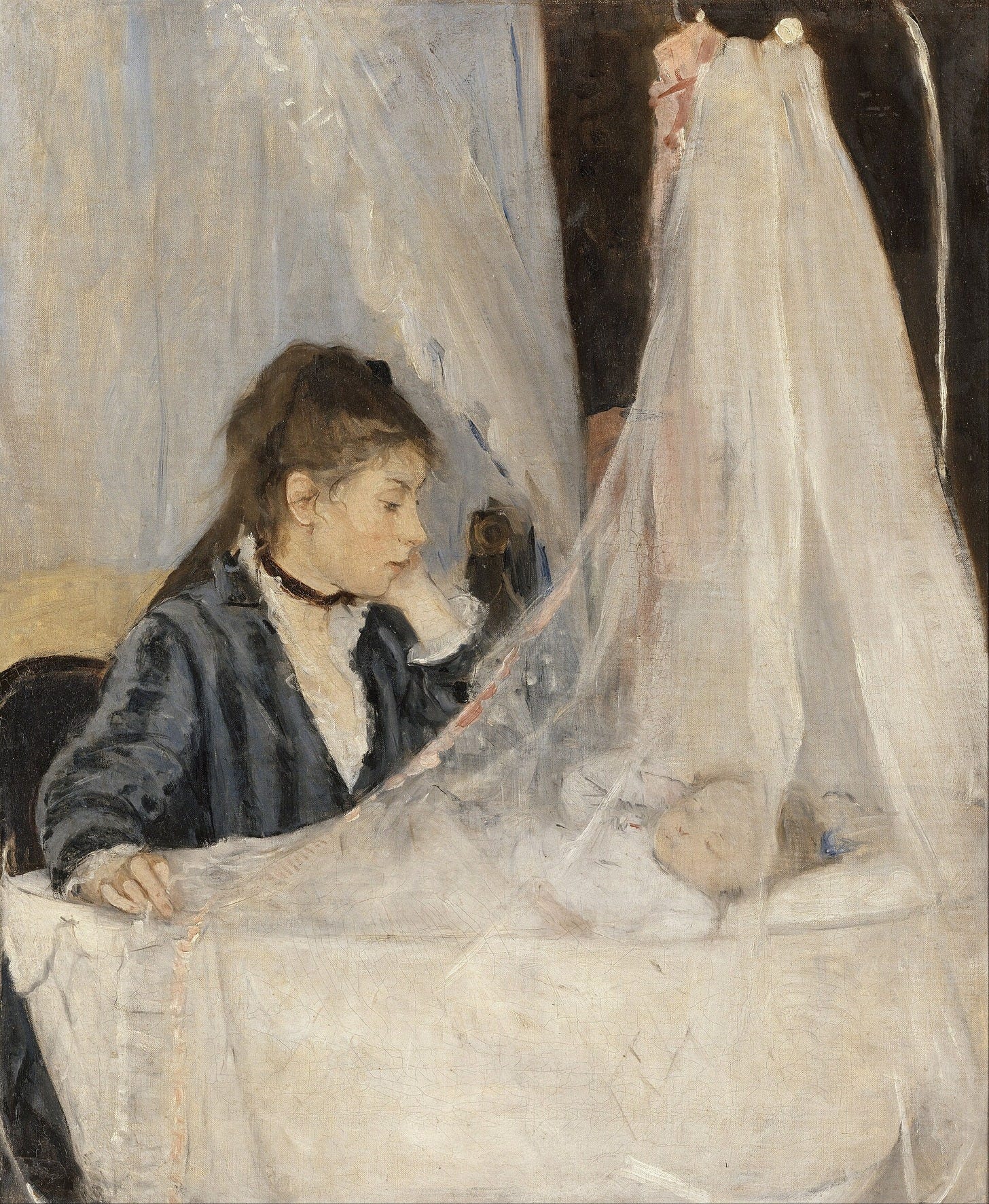
Artwork: Berthe Morisot, The Cradle (Le Berceau), 1872. Oil on canvas. Musée d’Orsay, Paris. Public domain.