


Skills We Were Never Taught — Issue 21
§
A spark, on its own, is almost nothing. It lasts less than a second and carries a jolt that stops us in our tracks. Whether it becomes a fire depends entirely on what it falls upon: the kindling, the paper, whatever was already lying there, laid down long before. We borrowed the word for love without borrowing the rest of the physics. We speak of the spark as though it came from the other person, struck across a crowded room, and almost never ask what in us what ignited it.
We have built a whole mythology around the spark. It is the scene the films linger on, the story retold at engagement parties, the beginning almost everyone hopes for. And we believe in it more now than we did a generation ago. In 2010, four in ten single adults in the United States said they believed in love at first sight. This year, according to the Kinsey Institute’s Singles in America study, it is six in ten, and nearly half say it has happened to them.
What the mythology leaves out is the middle of the story. In Australia, among marriages that end in divorce, the median time from wedding to separation is 9.4 years. In England and Wales, the median marriage that ends in divorce lasts thirteen years, the longest since records began. Close to a decade. Long enough to build a home, raise small children, and forget who you were before. Long enough, too, for a pattern to finish showing you what it is.
You may know both halves of this story. You may have felt that certainty, and you may now be living through its unravelling, or grieving it, or trying to understand how something that felt so sure could come to feel so lost. The feeling was not false. It was real, and it was powerful. It came from somewhere other than where you thought.
The spark you feel when you meet someone is your past recognising a pattern it already knows, and unless you can see that pattern, it is the one you will repeat.
§
Nobody chooses their first relationship. The first one is with whoever raised you, and it is learned long before you have words for it. How close people come. How long they stay. What a raised voice comes before. Whether a quiet room means peace or punishment. How much of you is welcome. By the time you are old enough to think about love, your body already holds a detailed map of what love feels like. Not what it should feel like. What it did.
That map does not live in the thinking part of you. It lives in the nervous system, which is built to do one job above all others: recognise what it has met before, quickly, so you know how to survive it. When you meet someone whose rhythm matches the map, the recognition is immediate and physical. Your attention sharpens. Something in you settles, or something wakes up. Conversation feels easy in a way it rarely does. You feel known.
That is the spark. The chemistry you felt in those first minutes was not information about the other person. It was your nervous system recognising a pattern from your past: the way love was given, withheld and earned in the house you grew up in. The spark is a memory, not a prediction.
The research on first meetings points the same way. When psychologists at the University of Groningen in the Netherlands measured love at first sight as it happened, in the laboratory and at speed-dating events, not a single instance was mutual. What people reported looked nothing like the intimacy and commitment of established love. It was strong initial attraction, which couples tend to rewrite as love once the relationship is underway. The feeling at first sight tells you very little about who is in front of you. What it tells you about is you.
Researchers who study relationships have long observed that people tend to be drawn towards the patterns they grew up inside, including painful ones. Much of that evidence is correlational, and no single study proves the mechanism. But the pattern is familiar to anyone who has spent years in rooms with couples: two people who each describe the beginning as the most natural thing that ever happened to them, and who are each, in their own way, describing home.
Familiar and safe feel identical from the inside. The body cannot tell the difference between “this is right” and “I have been here before”. Both produce the same ease. If you grew up with a parent who was warm and then suddenly unavailable, a person who is warm and then suddenly distant will feel less like a warning and more like chemistry. If you grew up managing someone else’s moods, a partner whose moods need managing will feel like purpose. If you learned that love has to be earned, someone slightly out of your grasp will feel like the real thing. In each case the spark is not telling you about your future with this person. It is remembering your past, and offering you the chance to live it again.
The same is true for them. Whoever you felt that spark with was feeling one of their own. Your pattern fitted theirs the way a key fits a lock, and both of you were handed your half as children. Neither of you chose badly. Each of you chose what felt like home, which is what any nervous system will do until it is taught to do something else.
So the question many people privately carry, if it felt so right, how did it go so wrong?, has an answer that is not about fault. It felt right because it was familiar. The spark recognised the pattern, and then, without either of you seeing it, the two of you repeated it. The moment you were most certain was the moment the blueprint was most in charge.
That deserves to be grieved. You did not imagine the depth of what you felt. You felt it completely. It was pointing backwards when you believed it was pointing forwards.
§
Most advice about chemistry comes in two forms. The first says trust it: follow your gut, when you know, you know. The second says ignore it: the spark fades, so choose sensibly. Both treat chemistry as either a verdict or as noise. Neither treats it as what it is, which is information about the past. It tells you which pattern you have found. It does not tell you what you can build, and those are two different questions. Most of us were only ever taught to ask the first.
The same Kinsey survey holds a second finding, and it rarely gets told as a love story. Nearly half of singles say they have fallen for someone they were not initially attracted to, up from three in ten in 2010. Asked what changed their minds, the most common answer was great conversation, followed by shared interests.
Consider what that describes. No recognition. No instant certainty. A person who did not register at first, and then, conversation by conversation, did. Attraction that grew where you could watch it growing. Attraction you had some say in.
We rarely tell those stories at weddings. “I didn’t think much of them at first” gets a laugh, as though the slow start were a flaw in the romance to be forgiven. It may be the most hopeful sentence in the whole subject of love. It means attraction is not only something that happens to you. Some of it can be built by two people paying attention to each other.
If your love arrived in an instant and then fell apart, nothing about that makes you foolish, and nothing about it makes you unlovable. It means you were running on a map you were handed as a child, as everyone is. You can see the map now, and seeing it is the first free act. That changes what you can choose next. Some love arrives. The kind that lasts is usually built.
One line needs to be drawn firmly. If the spark you felt was with someone who went on to frighten, control or harm you, none of this asks you to examine your part in it. Harm is not a pattern for you to rewire, and no one is owed your understanding while they are hurting you. Getting safe comes first. In Australia, 1800RESPECT (1800 737 732) is available at any hour. Elsewhere, your national domestic violence line can help.
When you think back to the first time you felt the spark with someone, what did it remind you of? Reply to this email or leave it in the comments. I read every one.
Sharon x
§
If this resonated with you, and you have found yourself here and would like to explore, try this sequence.
Recognition. Name the moment the spark arrived, and what it felt like in your body.
Example: “I knew within an hour. It felt like relief. Looking back, I had felt that relief before. It was the feeling of someone distant finally turning towards me, the same feeling I waited for as a child.”
Your recognition: When did the spark arrive with someone who mattered to you? What did it feel like, and where else in your life have you felt exactly that?
Reframe. Read the spark as a memory of the past, not a prediction of the future.
Example: “I thought the spark meant we were meant to be. It meant my body knew this pattern. The distance that hurt so much later was there on the first night, and it was part of the pull.”
Your reframe: What did your spark recognise? Which part of that pattern showed up later between the two of you?
Practice. The next time you feel the pull, with someone new or towards the person you already have, ask it three questions before you follow it.
Example: “When I feel the pull, I ask: Which home does this feel like? What happened in that home when things got hard? What does this person do when I am not easy?”
Your practice: Which of those three questions is hardest for you to answer honestly, and what would change if you knew the answer?
§
The Relational Human is a newsletter about the skills of intimacy. The ones no generation was ever formally taught, and the ones that quietly decide whether our lives, and the lives of those who come after us, feel like genuine connection or its prolonged simulation. Written by Sharon Alexandra: psychotherapist, behaviour specialist, educator, and writer. With rigour, with warmth, and with the conviction that none of this is fixed.
If this found the person who needed it, share it with the one who needs it next.
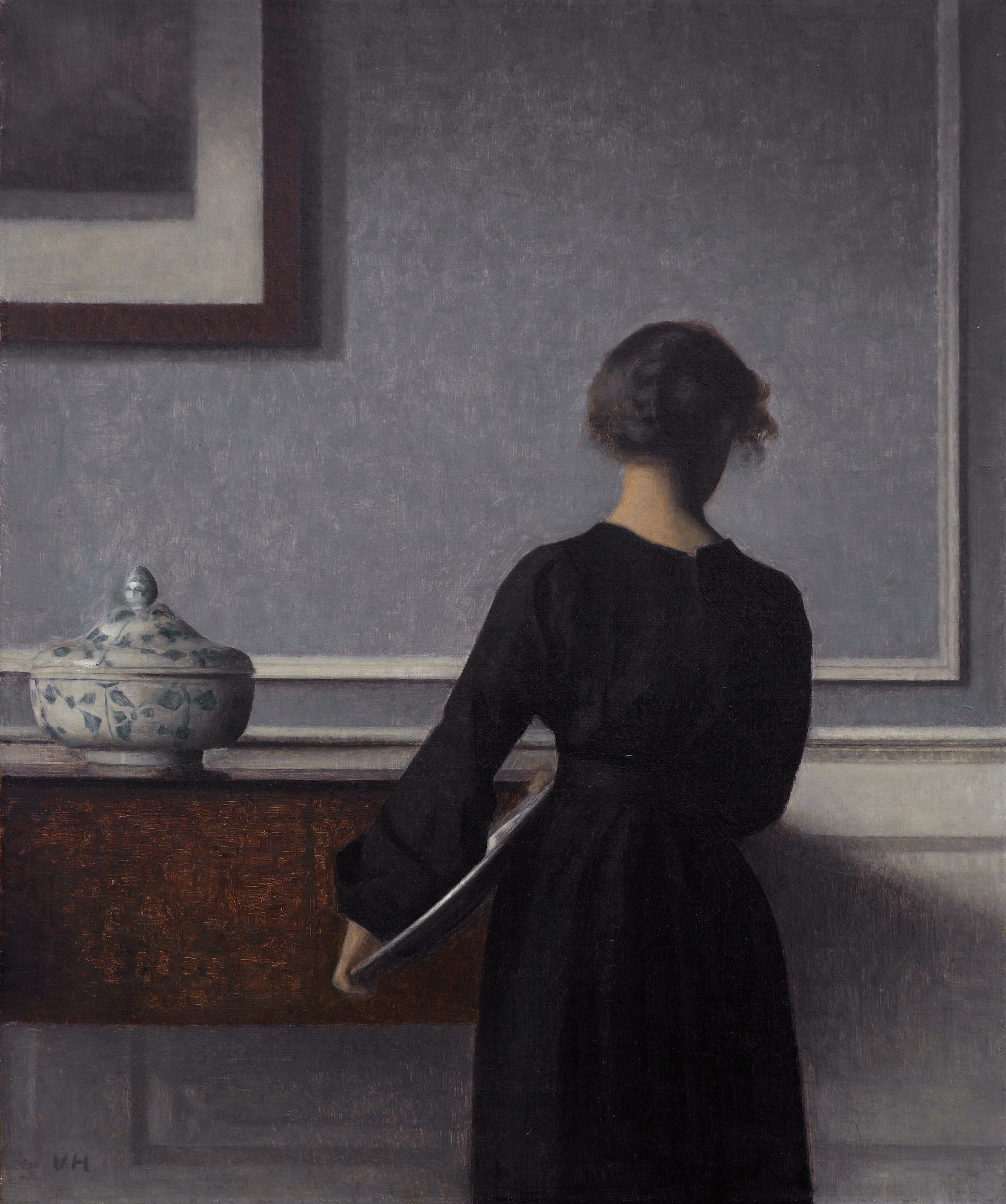
Artwork: Vilhelm Hammershøi, Interior with Young Woman Seen from the Back, 1903–1904. Oil on canvas. Randers Kunstmuseum, Denmark. Public domain.
Research notes
United States: Kinsey Institute with Match, Singles in America, 15th edition, 2026. About 5,000 singles, funded by Match.
Australia: ABS, Marriages and Divorces, Australia, 2025. 49,158 divorces granted in 2025; median duration from marriage to separation 9.4 years.
England and Wales: ONS, Divorces in England and Wales, 2024 and 2025. Median duration of marriages ending in divorce 13.0 years for opposite-sex couples in 2025, the longest since the series began in 1963.
Netherlands: Zsok, F., Haucke, M., De Wit, C. Y., and Barelds, D. P. H. (2017). What kind of love is love at first sight? An empirical investigation. Personal Relationships, 24, 869 to 885. Peer-reviewed.