


Skills We Were Never Taught — Issue 15
Something happens to a woman somewhere in her forties or fifties that neither she nor anyone around her can quite explain.
For twenty years she has been the one who absorbs. The one who lets the comment go, who reads the mood in the room and quietly adjusts to it, who carries the parts of the marriage nobody else notices are being carried at all. Then, across a year or two that no one can date precisely, she stops being able to. The same marriage, the same small daily unfairnesses she has swallowed without much complaint for two decades, begin to feel unbearable. Not worse than before. Unbearable in a way they simply never were. She cannot explain the change, so the people around her explain it for her, and every explanation on offer is wrong.
She is having a midlife crisis, they say. The children have left and she does not know who she is any more. It is the change, said with a small knowing look, as though her hormones have made her difficult and there is nothing to be done but wait it out. And underneath all of these sits the oldest explanation of all, the one medicine used for centuries and never fully put down, that a woman of this age is simply prone to coming undone.
None of it is what is happening. What is happening is quieter, more physical, and far more important, and once you can see it, the woman coming apart in these years stops looking like someone falling apart and starts looking like someone waking up.
§
What is really going on
For most of her adult life, a woman’s own body has been helping her keep the peace.
There is real chemistry behind the impulse to smooth things over, to accommodate, to give a relationship more than you get back and not keep a tally. Oxytocin, the same hormone that binds a mother to a newborn, is part of what makes all that accommodating feel natural rather than costly, and it leans on estrogen to do its work. While estrogen is high and steady, the system runs, and a woman can take on a great deal without it ever registering as too much.
Perimenopause, which usually begins in a woman’s early to mid forties, sometimes as early as the late thirties, and then runs on for anywhere from four to eight years, is when estrogen begins to go, not smoothly but in lurches, over years. And as it falls, the quiet chemical help that made accommodating everyone feel manageable falls with it. The urge to placate does not disappear. It thins. Which means a woman who has spent twenty years quietly metabolising an unequal marriage, barely noticing what it cost her, starts to feel every gram of it.
This is the part that matters more than any of the biology. What she feels when this happens is not a new problem. It is the true size of an old one. The imbalance was always there. Something in her chemistry was helping her not feel it. When that help withdraws, she does not become irrational. She becomes accurate. The marriage did not suddenly turn unfair overnight. She simply, for the first time, got a clear look at what it had been all along.
Everything turns on that. Her hormones did not invent the unfairness. They were hiding it. Perimenopause did not end her marriage. It ended her ability to not notice her marriage. Those are entirely different sentences, and the dignity of every woman in this story lives in the space between them.
§
The danger no one is screening for
There is a harder edge to all this, one that has been kept quiet for so long it is only now being properly studied, and it has to be said plainly, because saying it plainly is part of what keeps women alive. This is not the fashionable midlife-reinvention story, and it is not a metaphor. It is the most serious thing that happens in this window, and it is routinely missed.
For some women, the hormonal upheaval of these years does not only sharpen the view of a marriage. It manufactures a genuine, dangerous despair. Research has found women in the perimenopausal years far more likely to have thoughts of suicide than women before or after this stage, or than men of any age, and, most tellingly, that this holds even in women with no history of depression at all. One recent clinical study found roughly one in six women moving through perimenopause and menopause were carrying suicidal thoughts that had never once been identified or treated. And the risk runs higher, not lower, for women whose change arrives early.
Two things about this matter more than any statistic, and both are why it goes unseen. The first is that this despair often does not look like ordinary depression and does not show up on the standard questionnaires a doctor uses to screen for it, so a woman in real danger is told she is fine and sent home. The second is the hopeful one: when it is recognised and treated, often with hormonal treatment rather than antidepressants alone, it can ease dramatically. In one clinical group, suicidal thoughts fell by more than ninety per cent once the women were treated properly. Far too many, though, are handed an antidepressant for what was a hormonal crisis and left to wait years for the right help while it deepens.
Hold on to the distinction this essay has been building, because here it becomes a matter of life. When the buffer withdraws, it can sharpen a woman’s accurate perception of a marriage that really is unfair. That is real, and it is worth acting on. But the same withdrawal can also, on its own, generate a despair that is not a true reading of her life at all. It is a symptom. It is the storm, not the truth. And the cruelty of it is that from inside the storm, the despair feels exactly like clear sight. It is the one part of all this that must never be trusted as accurate, precisely because it is the part that lifts with the right care.
If any of this is describing you, please treat it as the medical emergency it is, and not a private failing you have to think your way out of alone. Tell a doctor, and ask directly about a hormonal assessment, not only an antidepressant. If the thoughts are here now, tell someone today, someone you trust, and a crisis line: in Australia, Lifeline is there at any hour on 13 11 14. None of this is the truth about your life. It is a symptom, it can be treated, and with the right care it can lift.
§
Why nobody ever told her
If it can be this serious, the obvious question is why almost no woman is ever told any of it while it is happening to her. The answer is a long and not very flattering history.
For as long as there has been medicine, a woman’s distress at this age has been given a name that pointed anywhere except the truth, and then treated with something that kept her quiet. For centuries it was hysteria, a word tied directly to the female body and used, at its worst, to lock away women who would not fall back into line. It sat in the medical books until 1980, which is close enough to now that the shadow of it has not lifted. Later it softened into the empty nest, a kinder story that placed a woman’s ache in the departure of her children rather than in her own changing body, because the children were a far more comfortable subject than the truth. And for the women many of us actually remember, it arrived as a remedy on a shelf. In this country it was a cup of tea, a Bex, and a good lie down, a powder pressed on the frayed and unaccountably miserable housewife that turned out, decades later, to have quietly destroyed a generation of women’s kidneys. Her daughter got the same message in a calmer bottle, prescribed to women at twice the rate of men, sold as the fix for the moods of her age.
Look at the whole line of it and the pattern is unmistakable, and it is not stupidity. It is convenience. Telling a woman the truth, that her body was ceasing to help her tolerate a genuinely unfair arrangement, would have raised a question about the arrangement. Calling it hysteria, or the empty nest, or nerves, and handing her a powder, raised no question at all. So for a hundred years the woman was quietened, and the arrangement around her was left exactly where it stood.
And the silence did not end with the powders. It runs right into the science itself. For something that happens to half the population, this transition has barely been studied. Menopause did not get its own dedicated research funding category in the United States until 2023, and the money attached to it remains a fraction of what flows to conditions that mainly affect men. The link between this hormonal shift and a woman’s mood, let alone her safety, is only now being taken seriously, and the researchers doing that work say plainly that the evidence is still thin, and that until very recently almost no one thought to ask the women themselves what they were living through. This is not a subject having a fashionable moment. It is a real and dangerous hole in what medicine ever bothered to know, being filled a century too late.
§
What it costs
Put the clarity and the exit in the same woman, and you have the thing the newspapers now call the grey divorce.
Because this generation has something none of the women before her had. She has, unevenly and never fully, somewhere to go. Her own money. A career that outlasted the years of small children. Her name on something. The plain legal standing to leave a marriage her grandmother could only ever have stood inside. So when the fog lifts and she sees the arrangement clearly, she can, for the first time in the whole history of her line, act on what she sees. Divorce among people over fifty has climbed sharply within a single generation, and a quarter of all divorces now end a marriage in which at least one person is over fifty. The steepest rise falls between about forty-five and fifty-five, the very years a woman’s estrogen is going.
The culture keeps a bright story ready for her, the midlife awakening, the woman who finally chose herself, and there is truth in it. But it skates over the cost, and the cost is real. A marriage of decades comes apart. A family reorganises itself around a fracture the children half saw coming and half did not. Grown children take sides, or grieve, or quietly exhale. Two people who built an entire life together discover how much of it was scaffolding around an arrangement that no longer holds. None of that is small, and this essay will not pretend the awakening comes free.
But there is one thing worth knowing, above all for anyone frightened of the decision. Women who leave these marriages do not, on the whole, regret it the way the fearful imagine. The low mood that builds in the years before a marriage ends tends to lift once it is over, which tells you something plain and important. For a great many of these women the marriage itself was the thing making them unwell, and the leaving was not the wound. It was the treatment. When most women who have been through both say their symptoms broke the marriage, the truer reading is that the symptoms did not break a good one. They ended a woman’s ability to keep tolerating one that had been quietly costing her for years.
§
The part that keeps it honest
It would be easy here to make the man the villain, and it would be false.
He is, most often, not a bad man. He inherited the other half of the same old arrangement, raised never to see the invisible work and never taught the things his wife was taught before she could read. And he usually carries a quiet loss of his own that no one names. Somewhere across the years his friendships thinned and his own supports fell away, until she became not only the manager of the household but the one person he confided in, his single emotional shelter. Part of the weight she is buckling under, in other words, is him.
None of that makes him wicked. It makes him, like her, the inheritor of a way of doing marriage built for a vanished world and never updated since. Which is the quiet truth underneath both the sedation and the divorce. This was never mainly a story about bad people. It was an arrangement that ran on two things going unspoken, a woman’s silence and a woman’s body helping her tolerate more than was fair, and both are now running out at once. The anger that finally arrives is not a flaw in her character turning up late. It is a fair account, presented the moment the two things that had been quietly subsidising the unfairness stop paying.
§
Before she decides anything
There is one hard-headed thing to say to the woman in the middle of this, and it is said out of respect for the clarity, not doubt about it.
The years when estrogen is swinging hardest are also the years it wrecks sleep and floods the mood, and a person running on broken sleep and a flooded mood is in no state to make a decision she cannot take back. So the wise order of things is not leave now or stay forever. It is steady yourself first. Get the sleep back, treat the symptoms if that is right for you, let the worst of the weather pass, and then look at the marriage again from level ground. If what you saw was true, it will still be true in six months, and you will be able to act on it as yourself rather than in the middle of a storm. If it was mostly the storm, that is worth finding out before anyone signs anything. Either way she deserves to make the largest decision of her second half of life with a clear head, which is the one thing a century of powders and pills was built to deny her.
§
A different shape for the second half
Say she steadies, and looks again, and the clarity holds. The culture has exactly one script for what comes next: grieve this marriage, and in time find another person to be your whole world instead. Same shape, new man.
More and more women at this age are quietly declining that script, and what they choose instead is the interesting part. Not another all-consuming partnership, and not a lonely retreat either, but a life built on more than one source of connection. The close friendships they finally have the time and the clear-eyedness for. Their own work, their own interests, the freedom to arrange a day without checking it with anyone. For a great many women the friendships of this stage turn out to be steadier and more nourishing than a rushed second marriage would ever be, and out of friends and family and the people they actually choose, they build something that holds them without asking one person to hold everything.
That points at the real thing that is ending, which was never marriage itself. It was one particular model of it, the one nearly all of us were handed, that asks a single relationship to be everything at once: your closest friend, your only confidant, your entire emotional shelter, and, if it fails, a hole you fill by finding one more person to carry the same impossible load. That model was always going to buckle. The people who spread their connection across a partner and friends and their own separate life, rather than piling all of it onto one person, simply do better, and always did.
And that is the balance worth ending on. None of this is an argument that she should leave, or that she should be alone. A marriage can be rebuilt into that wider, lighter shape just as surely as a single life can, and for many women that is the better ending: the same husband, freed from the impossible job of being her entire world, standing as one strong source of love among several. The point was never whether there is a man in the picture. The point is that no one person, and no one arrangement, was ever meant to be the whole of a woman’s life, and the model that quietly demanded she make it so is the model whose time is finally up.
So the truest thing this essay can offer the woman already at the sink, already clear, is not advice. It is a correction of the record. You are not breaking down. You are not your grandmother’s nerves or the pill your mother was quietly handed. What is ending is the long sedation, of body and of circumstance, that kept four generations of women from feeling the full weight and the full worth of their own lives. You get to feel it now, undulled, in the first moment in history that lets a woman do the one thing none of them were permitted: believe herself, and build what comes next from there.
None of what happens to her in these years had to arrive as an ambush, and that it so often does is the whole reason for writing any of this down. The grey divorce is not a fate written into a woman’s body. It is what happens when a nameable, predictable passage of life meets no language, no preparation, and no skills, so that it lands as a detonation instead of a season. The medical part of it needs a doctor, and this essay has said so plainly. But the relational part, the slow imbalance, the silence, the belief that love is earned by carrying everything, the moment the buffer thins and the truth comes into view, is not a mystery and not a doom. Give a woman, and the person beside her, an honest account of what is coming and why, the skill to say the hard thing while it is still small, and the awareness to tell the storm from the truth, and a marriage that would have ended in the dark becomes something two people can see, and name, and work through. That is the whole wager of this newsletter, and of a relational education more broadly. Almost none of this is fixed. What we keep calling fate is, more often than not, only a lesson nobody was ever given.
Whether that means remaking the marriage or leaving it for a life of her own choosing is not mine to say, and not the culture’s to script. It is hers. Possibly, for the first time, actually hers. And that, after a hundred years of tea and powders and pills, is not a woman falling apart.
It is a woman waking up in time to do something with the rest of it.
Sharon x
§
The Relational Human is a newsletter about the skills of intimacy. The ones no generation was ever formally taught, and the ones that quietly decide whether our lives, and the lives of those who come after us, feel like genuine connection or its prolonged simulation. Written by Sharon Alexandra: psychotherapist, behaviour specialist, educator, and writer. With rigour, with warmth, and with the conviction that none of this is fixed.
If this found the person who needed it, share it with the one who needs it next.
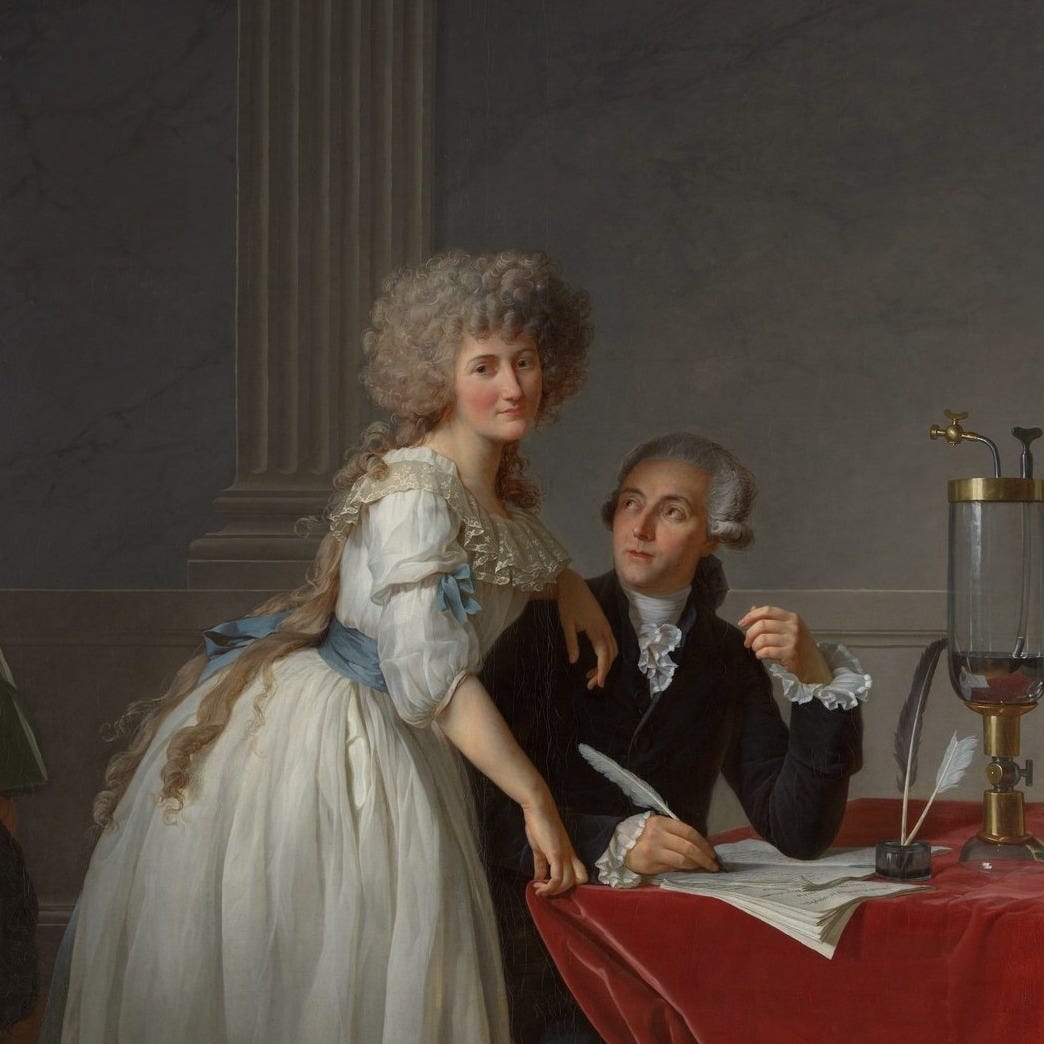
Image: Jacques-Louis David, Antoine Laurent Lavoisier and Marie Anne Lavoisier, 1788 — The Metropolitan Museum of Art, public domain