


Skills We Were Never Taught — Issue 14
For most of history, the woman running a household’s entire inner and outer life had no name for what she was doing, and no one to say it to who would have called it work.
That has changed, and recently. A generation of women now has the language: the mental load, emotional labour, over-functioning, the invisible work of anticipating everyone’s needs before they are spoken. They have the platforms to say it on and, for the first time in the female line, each other, a chorus of other women confirming out loud that the arrangement is an arrangement and not simply what a woman is. This is real progress, and it is the reason we can see the pattern clearly enough to write an essay like this one at all.
And here is the part that is unsettling. Naming a pattern does not release you from it. You can be fluent in every term above, able to diagnose the imbalance in someone else’s marriage in a sentence, and still walk into your own and run the exact arrangement your mother ran, because it is the only one you were ever shown. Knowing is not the same as not doing. If the marriage you grew up inside was held together by a woman quietly carrying all of it, then that is your picture of what love looks like, absorbed in the body long before you could examine it, and you will default to it fluently, even as your mouth is forming the critique.
§
The half-changed house
We can see how it started, if we go back far enough. There was a version of marriage where the roles were not in question. The man provided. The woman ran the home. It was rigid, and it was unfair in ways we have spent decades naming, but it was at least legible. Everyone knew their part.
We have moved a long way from that, and that is a genuinely good thing. Women work, earn, and lead. The old script has been torn up in the law, in the workforce, in what a daughter is now told she can become.
But a script does not leave the body as fast as it leaves the statute books. The homes most of us actually grew up in were caught mid-transition, running much of the old arrangement with a few pieces of the new laid over the top. Our mothers went back to work and carried the whole house anyway. Our fathers began to help and still waited to be told what to do. So what a child took in was not the clean new model anyone intended. It was the old pattern, lightly updated, presented as ordinary, and absorbed whole, before a child could question a line of it.
And both sexes were studying the same room. The girl learned that a woman earns and still holds the home together. The boy learned that a man pitches in when asked and is managed by a woman who keeps the rest in her head. Neither was taught it. Both simply watched it, on repeat, in the only classroom that forms us. It is the arrangement a great many of us are still playing out, without ever once deciding to.
§
The duties went well beyond what was disclosed
Every household has one. The person who holds the whole shape of it in their head at once: the appointments, the birthdays, the school notes, the expiry dates, the emotional temperature of every person under the roof, checked daily like a meter only one of them can read. It is not the visible chores. It is the layer underneath them, the anticipating and planning and remembering and carrying, the work that has no clock-off because it lives in the mind.
We have good evidence now for how unevenly this falls. Across two decades of data, women’s paid hours have climbed steeply while men’s share of the domestic and cognitive load has barely moved. And there is a specific failure mode inside it that clinicians name precisely, one many women will recognise from the inside. She finally says it out loud, and her partner, meaning well, answers: tell me what to do. It sounds like an offer. It is a promotion. Delegated tasks hand back the doing while keeping the deciding, the noticing, the remembering, all with her. The research frames it as supervisory labour stacked on top of anticipatory labour: now she runs the household and manages the person helping with the household. The offer to help, made in good faith, quietly enlarges the job.
This much is a marriage-level problem, and it is socialised and gendered and well documented. But it is not, on its own, the deepest part of the story, and mistaking it for the deepest part is why so many attempts to fix it fail.
§
The deeper root
Underneath the socialised imbalance sits something older and more specific, and it does not arrive with marriage. It arrives in childhood.
There is a well-established idea in the clinical literature called parentification: the child who takes on adult labour before they are ready for it. Researchers separate two kinds. Instrumental parentification is the practical version, the child who cooks, minds younger siblings, runs the logistics of a stretched household. Emotional parentification is the heavier one, the child who manages a parent’s moods, absorbs the family’s feelings, becomes the steady one so that someone unsteady can lean. Both teach the same lesson, and they teach it early, through what gets noticed and what does not. The meltdown got attention. The capable, agreeable, uncomplaining child got something better: relief on a tired parent’s face, a warmth that arrived only when she was useful.
Children are relentless pattern detectors. A few repetitions and the finding is filed as fact: closeness is not given, it is earned, and the currency is usefulness. Researchers call this conditional attention, and they have traced its long arc. The child formed this way does not leave it behind in childhood. Parentification predicts over-functioning in adult romantic relationships: the compulsion to become indispensable, to anticipate and provide and carry, to secure love by making yourself the one without whom nothing runs.
That is the distinction that matters, and it is the one worth holding separate. The mental-load imbalance is about how a particular marriage divides its work. This is about a belief a person carries into every marriage, every relationship, every room they have ever loved anyone in: that they must earn their place by being needed. The first is unfair. The second is a blueprint. And the second is the one that travels.
§
The women before her
No one chooses this belief, and almost no one installs it alone. It is watched, and then inherited.
The girl who becomes the manager of her marriage usually grew up studying one. She watched her mother run a household’s whole inner life on no visible fuel. She watched her grandmother do it before that, and her aunts, and the mothers of her friends, every woman she ever stood beside in a kitchen holding the same invisible clipboard. Nurture was the family trade, handed down the female line like the good china, and because it was everywhere, it did not look like a role. It looked like what a woman is.
So she took it up without noticing there had ever been a choice.
The reason this generation can finally see it, when the ones before could not, is not that women have become wiser. It is that they have become heard. Her grandmother almost certainly felt the whole weight of it and had no word for it, no money of her own, no legal standing, and above all no chorus, no other women saying plainly that the arrangement was an arrangement. So she absorbed it, called it duty, and passed the clipboard down. This generation is the first in the line with the language, the means, and the company of other women to name the thing out loud. That is worth honouring for exactly what it is. It is also why the rest of this essay matters, because being the first who can name the pattern is not the same as being the first to escape it.
§
The oldest joke about marriage
There is an old line about all this, usually told as a joke at a wedding. Women marry men hoping they will change. Men marry women hoping they never will. Everyone laughs, because everyone recognises it, and then nobody looks at what it is actually describing, which is two people walking into the same room wanting opposite things from time itself.
Take the woman’s half of it. She marries hoping he will change, which means she marries already braced to manage a gap between what is and what she needs, and management is the one skill she was drilled in before she could read. Hoping he will change is, quietly, a plan to carry the difference herself until he closes it. Take the man’s half without turning him into a villain, because he is not one here. He marries hoping she will not change, and often what he means, without the words for it either, is that he has found the one relationship he is allowed to bring his whole inner life to, in a culture that gave him nowhere else to put it, and he does not want to lose it. Two people, each formed by a different half of the same missing education, each betting on time to do what neither was ever taught to do on purpose.
Neither bet pays. He does not change, because being carried is comfortable and nothing in the arrangement is asking him not to be. She does change, but not in the direction the joke predicts. What changes in her is that the carrying stops feeling like love and starts feeling like the slow disappearance of a self.
§
The quiet exit, in stages
What happens next tends to move in stages, and they are quiet enough that from the outside almost nothing seems to be happening at all.
First comes disillusionment, private and unannounced. The gap she was managing stops looking temporary. She sees, clearly, that the arrangement is not a phase they are passing through but the shape of the thing itself.
Then, often, comes effort, and this is the stage the culture forgets. She does not leave. She tries. She names the load, calmly, in the correct language, and is met with tell me what to do, which we have already seen is not an answer. She adjusts, explains, hands over tasks and quietly takes them back when they are dropped. For a while she works harder at the marriage than she has worked at anything, which is itself the old belief still running: if it is failing, that must mean she has not yet been useful enough.
Then comes withdrawal. Not a slammed door. The opposite. She stops raising it, because raising it changed nothing, and the silence reads, from the other side of the kitchen, as things finally settling down. Issue 13 was about that silence and what it costs, the marriage that goes quiet and calls the quiet peace. This is very often how the quiet began.
And then, sometimes years later, the exit, which to everyone but her looks sudden and to her looks like the last item on a very long list. The numbers bear out the shape of it. Close to half of divorces are now initiated by women, and when researchers ask why, the most common answer is not a single betrayal or a dramatic rupture. It is general unhappiness, the accumulated weight of a life spent carrying what was never shared. The leaving was the loud part of a process that had been almost entirely silent.
§
What leaving does not fix
The hardest thing to say to a woman who has finally, and rightly, walked out has to be said with care, because it is so easily mistaken for telling her she should have stayed.
She should not have to stay. Some arrangements have earned their ending, and a partner who was told plainly and chose comfort anyway has answered the question of who he is. And if the silence in a relationship exists because speaking is not safe, because of what a partner might do, that is not a pattern to renegotiate at all. That is a situation to get safe from, with real support, first. Nothing here argues anyone back into a marriage.
But if what she carried out of the marriage was the exhaustion, while the belief that produced it stayed packed in with everything else, then something predictable happens, and the research on pattern persistence is blunt about it. The over-functioning was never located in that house, with that man. It predates him. It predates every him. She was earning love before she could spell it. So it comes with her. Within a year or two of the next serious relationship she is, somehow, the one who remembers his mother’s birthday, managing again, anticipating again, tired again, and the available explanations narrow cruelly to two. Either something is wrong with her, which is unbearable, or something is wrong with men, all of them, which the whole internet is standing by to confirm.
That second conclusion is understandable, arrived at by reasonable women, and it is a misdiagnosis. The men are owed no free pass; plenty take far more than they carry and settle their own accounts poorly. But the one constant across every relationship a person has ever had is not the other people. It is the belief they bring into the room. That is not an accusation. It is the single most useful fact available, because you cannot renegotiate other people, and you can, slowly, renegotiate a belief. All men are like this is a life sentence. I was taught that love has to be earned is a place to start.
§
Restructuring the foundation
The real work, in the end, is not the chore chart, and it is not only the lawyer, though either may have its place. The real work is on the foundation the whole structure was built on: the belief, absorbed in childhood and rehearsed for decades, that your place in a relationship is something you buy with usefulness.
That belief is renegotiable, and the renegotiation is smaller and stranger than it sounds. It looks like letting someone do something for you and not repaying it by the afternoon. It looks like saying you are struggling without softening it into a joke, and letting it be held. It looks like noticing the exact moment the old instinct fires, the urge to make yourself indispensable inside the first month, and declining to act on it, and tolerating the discomfort of being loved while doing nothing to earn it. Every time the earning does not happen and the love does not withdraw, the old arithmetic loses a little of its authority.
None of this settles whether any particular marriage should continue. Some should not. But there is a difference between leaving a marriage and leaving a pattern, and only one of them changes the next chapter. The generation that can finally name this out loud is also the first with a real chance to do more than name it: to rebuild the foundation rather than move house and raise the same walls somewhere new.
There is one more layer underneath even this, a biological and historical one, the reason so much of it surfaces at a particular age and arrives as a wave of midlife divorces that look, from the outside, like women coming apart. That is next issue. Because the timing is not an accident, and it is not a breakdown, and it deserves its own telling.
Sharon x
§
The Relational Human is a newsletter about the skills of intimacy. The ones no generation was ever formally taught, and the ones that quietly decide whether our lives, and the lives of those who come after us, feel like genuine connection or its prolonged simulation. Written by Sharon Alexandra: psychotherapist, behaviour specialist, educator, and writer. With rigour, with warmth, and with the conviction that none of this is fixed.
If this found the person who needed it, share it with the one who needs it next.
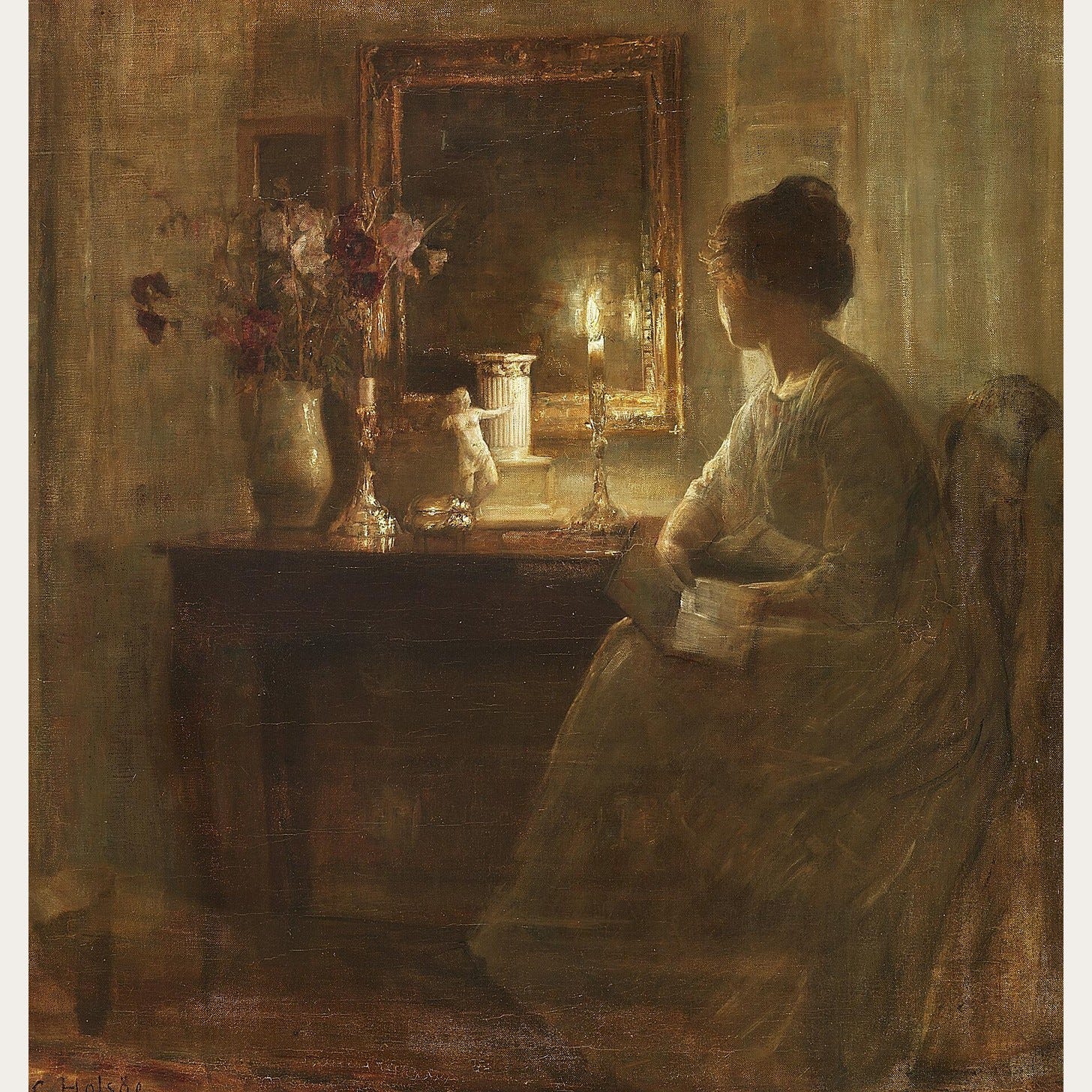
Artwork: Caspar David Friedrich, Woman at a Window, 1822. Oil on canvas. Public domain.