


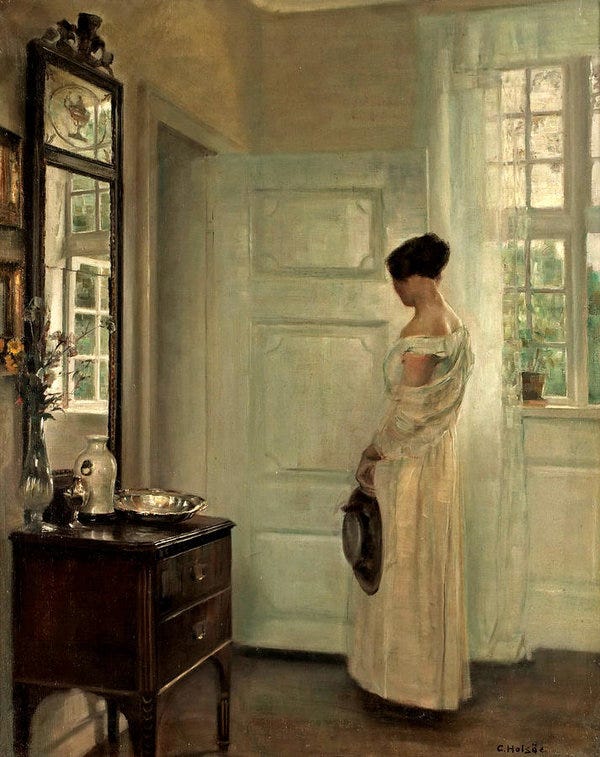
Artwork: Carl Holsøe, Interior with a Woman in a White Dress. Oil on canvas. Public domain.
Skills We Were Never Taught — Issue 13
For most of human history, a person struggling in their marriage told almost no one. Maybe a sister. A mother, if that relationship allowed it. One or two friends who had known them both for years. The circle was small, and its smallness was a kind of accuracy: the people you confided in had context. They had met your husband, watched the two of you across a decade of dinners, knew your family and his, and often they had heard both sides, sometimes from the other side directly. When one of them finally offered a verdict, it was calibrated to the actual people involved, and it came from someone who would still be there next year to see how it aged.
That world is largely gone, and its replacement arrived so quietly that almost nobody has stopped to weigh the exchange. Now a person struggling in their marriage can tell forty thousand strangers before breakfast. A large and fast-growing share of the community takes its grievances online, to the attachment forums, the breakup boards, the endless commentary beneath every post about love: one side of one story, published at its worst hour, to an audience that has never met the other person and never will.
This essay is about what that exchange costs. Because the strangers are not neutral, and the picture they hand back is drawn in a very particular hand.
§
Everyone in the room is hurting
Spend real time in the internet’s relationship quarters and one thing becomes obvious, and impossible to unsee. Everyone in the room is hurting. That is not an insult; it is the room’s purpose. These are spaces for people mid-shipwreck: the freshly left, the chronically anxious, the ones lying awake dissecting a text message like scripture. The forums for surviving breakups with avoidant partners are among the fastest-growing corners of the whole ecosystem.
But notice who is not in the room. The best research puts secure attachment at a little over half of adults, five or six people in every ten who move through love without chronic alarm, who trust reasonably and repair quickly and tolerate distance without spiralling. They are the majority of the human relational experience, and they are almost entirely absent from the places where the internet teaches itself about love. They are not posting at 2am, because they are asleep. They are not dissecting the text message, because they asked about it over dinner and it resolved in ninety unremarkable seconds. Contentment, it turns out, does not generate content.
And on the rare occasion a secure voice does wander in, something telling happens. The reply is short, measured, something like: have you tried telling him how you felt? And the room, which runs on intensity, scrolls past it. The calm answers sink and the dramatic ones rise, because every feed on earth rewards activation, and a nervous system in alarm makes better engagement than one at rest. The algorithm is not neutral about attachment. It has a type.
So the wounded are drawing the picture. And everyone else is learning love from it.
§
A picture painted from wreckage
Ask a divorce lawyer what marriage is like, and after enough years the answer turns bleak, because a divorce lawyer has never once met a happy one. The happy marriages never walk through the door. Every case that lands on the desk is, by definition, one that broke, and a whole career spent inside that sample teaches that marriage is mostly betrayal, attrition, and the slow division of a life.
The relationship internet is that same distortion, except nobody had to spend a career earning it. The people posting are, overwhelmingly, the ones whose relationships are hurting them right now. Every thread is a case file from someone’s worst week. Every list of signs, every taxonomy of partners who will hurt you, has been assembled, in good faith, from the wreckage. And a picture of love painted only by the people it is currently wounding has a particular character: it is all wreckage. The ordinary calm that most relationships run on for years, the version where nothing much is wrong, appears nowhere in it, because nobody living inside that calm ever had reason to paint it.
The most corrosive thing such a picture teaches, mostly by accumulation, is that the ordinary weather of an ordinary relationship, the flat weeks, the mild irritations, the desire that ebbs and returns, is evidence. Post your quiet Tuesday and the forum will show you, within minutes, three divorces that began exactly like it, and you will not be wrong that they match. Almost every marriage on earth matches the opening chapters of a divorce. The chapters that distinguish them, the repair, the return, the ten thousand undramatic recoveries, were never posted. The instrument only detects storms. Point it at any sky and it will find one.
One line needs drawing firmly before going on. Some of the people in those rooms are not misreading anything. Some are naming real mistreatment for the first time, in the only place that ever believed them, and their alarm is not insecure attachment but accurate perception. Nothing here asks anyone to override the signal that something is genuinely wrong. The argument is with the picture, not with any person’s own eyes.
§
The picture has two authors
There is a second distortion in the picture, stranger than the first, because it means the wreckage itself is sorted into two piles that never touch.
Go looking for what men say about love online, and then for what women say, and they are not having the same argument. They are not even in the same room. The women’s conversation is, overwhelmingly, about men they already have: the partner gone quiet, the one who will not commit or will not talk, the household running on her attention alone. The refrain, across a thousand threads, is a weary there are no good men left, spoken from inside relationships with men who are, technically, right there in the house. The men’s conversation is, overwhelmingly, about women they cannot get: the date that never happens, the message that goes unanswered, the door that will not open. One line compresses the whole asymmetry: women complain about the men they are with, and men complain about the women they are not with.
It is measurable, and it is large. Recent data finds roughly six in ten men under thirty single, against about a third of women the same age. On the apps, most men reported feeling insecure at how few messages they got; most women reported feeling swamped by how many. These are not two distortions of one shared reality. They are accurate reports from two genuinely different positions on the same terrain, which is exactly why neither believes the other.
§
Two dialects of the same loneliness
Each has learned to speak about love in a dialect the other was never taught. The women’s conversation runs on the language of the interior: needs, attachment, emotional labour, the whole vocabulary of what a relationship should feel like from the inside. The men’s runs on a different axis entirely: not the quality of the connection but the fact of it, access, rejection, whether the door opens at all. And the data complicates the popular story here. Men are not measurably lonelier than women; the rates are almost identical. What differs is where they are allowed to take it. Men are far less likely to bring an inner life to a friend, a sibling, a parent, anyone. For a great many, a partner is not one source of emotional sustenance among several. She is the only one. So I cannot get a date is not, underneath, a complaint about dating. It is a complaint about having no way in to the one relationship a man was raised to stake his whole emotional survival on.
When the two conversations collide, each hears the other as an attack. She says she is exhausted from carrying the relationship, and he hears that he personally has failed, or that men are being indicted. He says nobody will give him a chance, and she hears entitlement, a man who thinks attention is owed. Both are speaking honestly about real pain. Neither has the dialect to receive the other’s.
§
Two salesmen
A vacuum this large does not stay empty, and two industries have moved into it. It is worth being scrupulously fair to both, because they are more alike than either would ever accept.
To the locked-out young man, one industry offers instant relief: the problem is not that nobody ever taught you how to build closeness, it is your status, your softness, a world quietly rigged against men. Harden, dominate, and the door opens. The best-known versions find enormous numbers of teenage boys through fitness and money and discipline content first, and slide the framing about women in later.
To the disappointed young woman, a different industry offers its own tidy relief: the problem is not a skill that neither of you was taught, it is him. His avoidance, his attachment style, his flags of whatever colour. A taxonomy arrives to diagnose him with, and it leads, nearly always, to the same conclusion: this is who he is, you deserve better, go.
Their symmetry is the whole point. Each takes the same real deprivation, the total absence of any relational education, and sells back an answer with an enemy inside it. His enemy is women, or the system. Hers is men, or this particular man. Each swaps a missing curriculum for a target, because a target relieves the ache immediately and a curriculum takes years. Neither is selling love. Both are selling an exit from the discomfort of not understanding, which is a different product, and a much worse one.
§
The same missing lesson
Strip the ideology off both sides and the same thing sits underneath, on each side. A generation can name what it wants from love with more fluency than any before it, and still cannot do the thing. The woman who can label every one of her partner’s attachment behaviours and still cannot land a single repair. The man handed no vocabulary at all, who cannot get to the first conversation where the vocabulary would even matter. One has the words without the enactment; the other has been given neither. But the hole is the same hole, and it is not a defect in the other sex. It is a lesson that was delivered to nobody.
And so each conversation hardens into the same error, printed in mirror image. The woman who runs the same inherited pattern through relationship after relationship and concludes that all men are like this. The man who cannot get in, over and over, and concludes that women are like this. Same logic, same comfort, same mistake. In both, a skills vacuum has been misread as a flaw in the other sex, because that is far easier to carry than the truth, which is that nobody was taught, the teaching is still there to be had, and the work belongs to you. All men are like this is a life sentence. I was never taught this is a skills gap. Only one of them has a curriculum.
§
Where the real picture was all along
The correction is almost embarrassingly analogue, and that is precisely why it works. The missing data was never online. It is walking around your actual life.
It is in the couple two doors down, married thirty-one years, whom nobody has ever asked. Ask them, not for their secret, they will wave that off, but for something specific: what happens after a fight. And notice how disappointing the answer is. Someone makes tea. Someone half-apologises while emptying the dishwasher, and the other one accepts the half because they know the whole is in it. Nobody names a style. The disappointment you feel hearing it is the tell. You have been trained on drama, and the truth was always going to taste bland after a decade of the feed. The blandness is the knowledge.
And it is in the next room, where your actual relationship is, the one the forum has never met, and the one no algorithm and no salesman was ever measuring. The experiment none of them can run for you is available tonight, and it is the one this newsletter keeps arriving at from every direction: say the thing to the person. Not to the strangers, about them. To them. You went quiet at dinner and I noticed I got scared. Eleven words, spoken in the room where the context lives, will tell you more about your particular relationship than the entire archive of the wounded internet.
Which means refusing both pictures: the one that says the other sex is the enemy, and the one that says your ordinary weather is a diagnosis. Neither was painted from where you actually live. The wounded painted the first, in the worst weather of their lives, and it is a true picture of that weather and nothing else. The salesmen painted the second, and handed you a target so you would stop looking for a teacher. Neither has the ordinary good in it, because the ordinary good never gets painted. Most relationships are lived out quietly, without incident, by people with nothing to report, and most of the distance between the man outside the door and the woman disappointed within it is not hatred. It is untranslated. And translation is a skill as well. It was simply never taught, to either of them, and it still could be. The only way to see the real thing is to put the borrowed picture down and look at the person actually in front of you.
Sharon x
§
The Relational Human is a newsletter about the skills of intimacy. The ones no generation was ever formally taught, and the ones that quietly decide whether our lives, and the lives of those who come after us, feel like genuine connection or its prolonged simulation. Written by Sharon Alexandra: psychotherapist, behaviour specialist, educator, and writer. With rigour, with warmth, and with the conviction that none of this is fixed.
If this found the person who needed it, share it with the one who needs it next.