


Skills We Were Never Taught — Issue 19
“I’m taking a break from dating.”
Everyone has said it, or heard it, or watched a friend announce it over drinkd with the particular brightness of someone ninety per cent sure of a decision. And the culture has two ready-made stories to file it under. In the first, this is triumph. They have deleted the apps, gone on a dating detox, stopped chasing people who could not care less, chosen themselves at last, and good for them. In the second, told more quietly and usually behind their back, they have given up. Unlucky in love one too many times, they have quietly retired from the field, and we feel a little sorry for them and hope it does not harden into something permanent.
Both stories, the triumphant one and the pitying one, miss the same thing. From the outside, they are indistinguishable. Two people can step away from dating in exactly the same way, delete exactly the same apps, and be doing two completely opposite things. One is resting. The other is hiding. And nobody watching, sometimes not even the person themselves, can tell which, because the entire difference is happening on the inside.
§
Stepping away is often exactly right
The obvious thing first, because the rest of this essay complicates it and I would not want the complication mistaken for a sneer. Stepping away from dating is, very often, precisely the right move, and the instinct behind the dating-detox wave is a healthy one.
Modern dating, for a great many who try it, can turn into a burnout machine: an endless carousel of low-effort attention, curated profiles, unsatisfying dates, and the peculiar exhaustion of performing desirability to strangers who give little back. The evidence here is still mostly correlational, so nobody can hand you proof that the apps themselves cause the misery, but the fatigue people report is real and widespread, and anyone with sense arrives at a point where getting off the ride is the only sane response. Underneath the tiredness is something worth naming, because it is the real quarry. A great many of us have spent years with the central romantic question pointed the wrong way. Not am I interested in them, but are they interested in me. Not what do I want, but what would make them choose me. That is a spiral, and stepping out of it long enough to turn the question back around, to remember that you are a person with preferences and not merely an applicant hoping to be selected, is one of the more self-respecting things anyone can do. On all of that, no argument at all.
§
The noise from everyone else
Before any of that inward honesty is even possible, there is the noise to get through, and the noise is considerable. Choosing to be alone, or simply being alone, turns out to be one of the few life decisions that near-strangers feel entitled to have loud opinions about. When are you going to meet someone. Have you tried the apps. You are too fussy. You will find someone the moment you stop looking. Under all of it runs the same quiet assumption, that a single life is a waiting life, a departure lounge, a problem with a solution everyone else can see more clearly than you can.
Researchers even have a name for this, singlism, the low and rarely examined bias that treats being coupled as the finished state and being single as the unfinished one. Most of us never call it discrimination, which is part of why it works so well: the assumptions get to travel as concern. And it does real damage. The studies are consistent that single people surrounded by coupled friends and family tend to feel worse about their singleness, not better, because the pressure and the pity arrive dressed as love. The result is a peculiar, exhausting tax: the steady, low-grade sense that you owe everyone an explanation, that your life as it stands needs a justification theirs never will.
And this is worth observing plainly, because almost no one does. The people most uncomfortable with your contented singleness are very often the ones least at peace in their own relationships. Someone genuinely happy in a good partnership rarely needs you to be partnered too. But someone quietly enduring a marriage they will not look at directly can find your freedom faintly unbearable, because it raises the exact question they have worked so hard not to ask. Your aloneness becomes a mirror, and not everyone likes what it shows them, so they hand the discomfort straight back to you in the shape of worry about your future. When that happens, the anxiety in the room was never yours. It has simply been assigned to you. And a great deal of the shame single people carry turns out to be precisely this: other people’s unexamined fear, quietly transferred, and then mistaken for your own.
§
Resting, or bracing
So if stepping away can be this healthy, where is the catch. The catch is that the identical act can also be the exact opposite of healthy, and telling the two apart is the actual skill.
A restorative pause and an emotional shutdown look the same from the street. Both involve not dating. The whole difference is in their posture. A pause is a door left ajar. You have stepped back to rest, to recover, to get clear, fully intending to walk through again when you are ready, as a different person from the one who stepped out. A shutdown is a door quietly bolted from the inside. You are not resting. You are bracing. The dating has stopped not because you are restoring yourself but because you have decided, somewhere below the level of a decision, that the risk of being hurt again is no longer one you are willing to run. “I don’t need anyone” is the sentence both of them use, and it can mean two very different things. It can mean that your worth and your steadiness do not depend on being partnered, which is autonomy, and it is true and freeing. Or it can mean that needing anyone at all now feels too dangerous, which is not the absence of need but a way of managing it, of playing it down and leaning hard on yourself because closeness has come to feel unsafe. The two sentences sound identical and are not, because independence is not the same as emotional exile.
The tell, though, is not how long the break lasts, and it is not whether you feel ready to date again, because after enough hurt you may not for a good while, and that is allowed. The tell is direction. A restorative pause tends to make a life larger. You come back to your friendships, your own interests, the things dating had quietly crowded out, and something in you loosens and clears. A shutdown makes a life smaller. The withdrawal is not really in service of anything; its main job is to make sure nothing can hurt you again, and over time it can become self-reinforcing, because keeping everyone at a distance also keeps out the very experiences that might have changed your mind. One is a season with room in it. The other is closer to a wall, and walls are easier to live behind when someone hands you a flattering word for them.
§
How to tell which one you are in
Since the two are invisible from the outside, the honest work is inward, and it comes down to a handful of questions only you can answer.
When you imagine dating again, what is the feeling underneath. Tiredness is a pause; you are simply not rested yet. A flare of fear, or a hardening, a flat and final “never again,” is worth a closer look, because that is more often a wall than a rest.
Does this break make your life larger, or smaller. That is the best single question there is. A pause opens things out, more friendship, more rest, more of whatever you actually value. A shutdown quietly narrows everything down to the management of risk.
Are you choosing it because it serves something you want, or because it lets you avoid something you fear. Both can be true at once, a person can be genuinely worn out and also frightened, so the real question is which one is steering. And is the avoidance staying neatly inside the romantic department, or leaking, so that you find yourself less available to friends and work and joy as well. It usually leaks.
Can you imagine closeness as difficult but still possible, or only as dangerous. Even a genuinely good person can feel like a threat when your nervous system has learned to treat closeness as a hazard, and noticing that the alarm is yours to examine, rather than a verdict on everyone who comes near, is most of the work.
And, quietly, the important one: are you allowed to change your mind. Not made to, allowed to. The freedom to move is the real marker here, far more than any performance of being open to romance. A person can choose years of contented singleness and stay perfectly free. Another can go on dates every week from behind a bolted door.
None of these has a wrong answer. A wall can be exactly what you need for a while, after enough hurt. But you cannot decide to take it down if you will not first admit it is there, and that is the one thing the language of empowerment quietly makes so hard, because it hands you a flattering word for the wall and removes the reason to ever question it.
§
The trouble with “I chose me”
This is where the culture’s trending phrase gets complicated. “I chose me” is one of the great slogans of the moment, and like all great slogans this can be true in one mouth and a costume in another.
Chosen singleness is real, and it can be magnificent, not because single people are somehow free of loneliness or never want love, but because a good life has never required romance as its sole proof of meaning. A person can build a life so full, of friendship and work and freedom and purpose, that a partner would be an addition to it rather than the point of it, and that life needs no apology and no asterisk. The research is careful here, and worth being careful with: choosing singleness does tend to come with less of the specific ache of romantic loneliness, but it does not magically hand anyone better mental health, and pretending it does simply swaps one pressure for another. An earlier essay in this run made the core case anyway: no one person was ever meant to be your whole world, and a rich life held across many sources of connection is not a consolation prize. The point is not to win at being alone. It is to build a life that is genuinely yours. If that is your “I chose me,” then choose away.
But the same three words can also be defensive singleness wearing the season’s colours. “I chose me” can quietly mean “I chose me because choosing anyone else has hurt too much,” which is not a choice so much as a flinch with good branding. And there is a subtler trap still, the one the sharper critics of the dating-detox movement have spotted. A great deal of empowered singlehood is secretly still organised around eventually being chosen. Spend your single year becoming your best self, the story goes, heal your wounds, get yourself sorted, so that you will be ready for the right person when they finally arrive. Which sounds healthy and is really just the old validation game rescheduled. You are still preparing to be selected. You have merely moved the audition to next year. Genuine singlehood is not a waiting room with better lighting. It is a life you would be glad to keep.
§
What the pause is actually for
If a pause is going to be more than a rest between rounds, it needs a job, and the job is not self-improvement in the beauty-pageant sense. It is two things, mostly.
The first is to see the pattern you cannot see while you are inside it. You cannot study your own relational habits mid-relationship any more than you can read the label from inside the jar. Stepping back is the one vantage point from which the thing you keep doing, the type you keep choosing, the role you keep sliding into, the exact moment you always abandon yourself, finally becomes visible. And that visibility is the real prize, because a pattern you can see is a pattern you can begin to change, while a pattern you cannot see will simply go on choosing your next partner for you, precisely as it chose the last one. And the pattern is often older than any single relationship. Its roots can go a long way back, to the house you grew up in and how you first saw love done, though it has been shaped by everything since as well, by later relationships and culture and plain circumstance. It is an influence, not a sentence. A quiet, single stretch is simply the first room you have been in that is still enough to let you hear it clearly.
The second is to build a life that is good on its own terms. Not as bait, and not as a holding pattern, but because a good life is the point of a life. The friendships that get the attention a scarce partner usually monopolises. The work, or the play, or the quiet, or whatever it was you stopped making time for while you were auditioning. The paradox, which everyone discovers and nobody quite believes in advance, is that a life built this way is both complete in itself and, if you do end up wanting a partner, the very thing that lets you choose one well, because you are choosing from fullness rather than from hunger, and fullness has far better judgement. None of this makes a partner unnecessary, which is the part the empowerment slogans keep getting wrong. It makes a partner less likely to become your only source of safety, or identity, or belonging. Autonomy and connection were never opposites. The healthier version of being alone is not a life with no need in it. It is a life with more than one place to put the need.
§
The question to consider
So the question worth putting to yourself, if you are single by choice or thinking of becoming so, is not the one the culture keeps arguing about, single or coupled, empowered or lonely. There is no prize for being partnered, and none for being unreachable either. The quieter question is whether your solitude is a place you can live more freely from, or a place you have backed into so that nothing can get to you.
There is no wrong answer to being single. There is only an unexamined one. Chosen time alone can be genuinely restorative: it lowers the noise, makes room to hear yourself, and hands you back the friendships and interests that dating had crowded out. It turns less free only when its main job stops being to make room for a life and starts being to make sure nothing can hurt you again. That shift is one only you can feel, and only you can be honest about.
So be honest about it, and then, whichever it is, choose it on purpose. The good kind of alone is not a waiting room for love, and it is not a fortress against it. It is a life with enough autonomy and meaning and connection in it that a partner, if you ever want one, can be someone you choose, rather than proof that you were worth choosing. Do not ask only whether the door is open or shut. Ask whether it is yours to move. The good kind of alone is the kind you can walk in and out of with your eyes open.
Sharon x
§
The Relational Human is a newsletter about the skills of intimacy. The ones no generation was ever formally taught, and the ones that quietly decide whether our lives, and the lives of those who come after us, feel like genuine connection or its prolonged simulation. Written by Sharon Alexandra: psychotherapist, behaviour specialist, educator, and writer. With rigour, with warmth, and with the conviction that none of this is fixed.
If this found the person who needed it, share it with the one who needs it next.
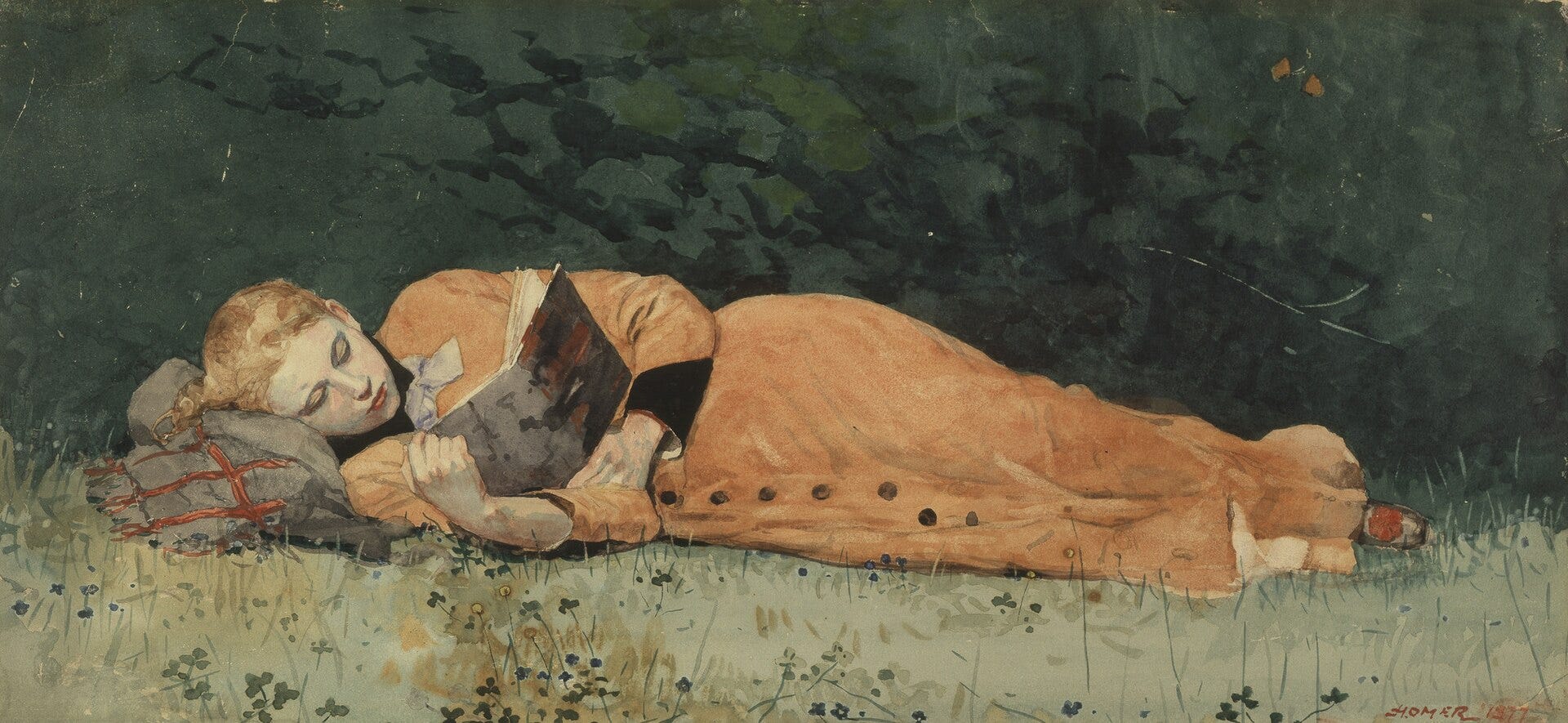
Artwork: Winslow Homer, The New Novel, 1877. Watercolour on paper. Public domain.