


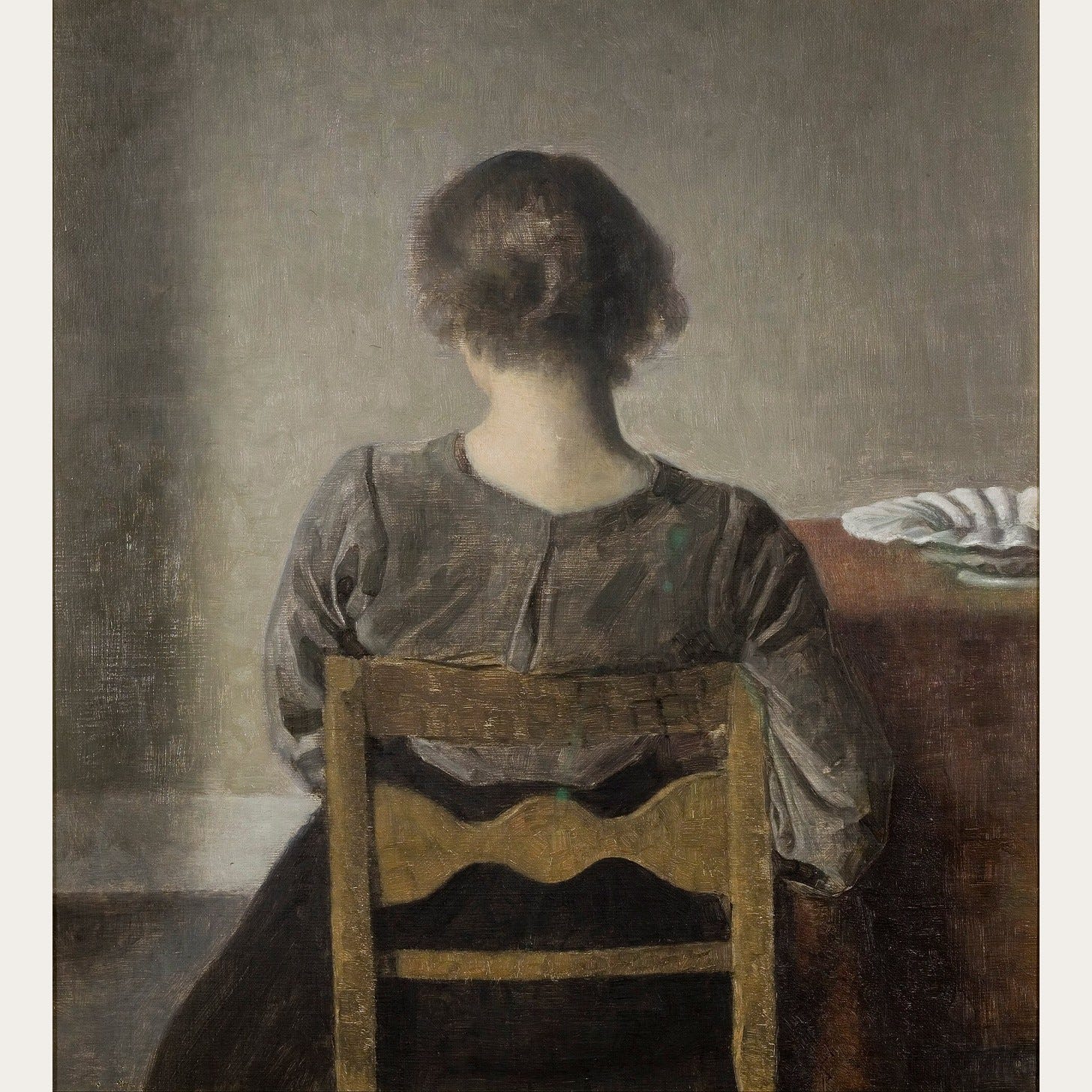
Image: Rest Vilhelm Hammershøi · 1905 Musée d’Orsay, Paris
Skills We Were Never Taught — Issue 13
The last real argument they ever had was about a wet towel on the bed. Neither of them knew it was the last one. Nobody ever does; that is not how these endings announce themselves. There was no slammed door, no decision, no final scene. Just an ordinary evening that turned out, years later, to have been the last time either of them cared enough to fight.
Tonight the house is quiet, and both of them would call that peace. The dishes are done, nobody is upset, and if you asked either of them how the marriage was, they would say fine, and mean it, and not be lying.
They would not be telling the truth either. Because there was a time when an evening this settled would have held a skirmish somewhere inside it: the towel, the tone he used on the phone, the plans she made without asking. It would have flared, and stung, and been survived. Then, on some evening neither of them can name, the skirmishes stopped, and they both remember it as things finally getting easier.
What stopped is worth looking at closely. What it was actually made of.
§
The last argument
Arguments, it turns out, are acts of faith.
A person only keeps raising a complaint while some part of them still believes that raising it might change something. The complaint is exhausting, and humiliating, and it almost never comes out clean. But underneath its bad wrapping, a complaint is still contact. It says: I still expect something from you. I am still holding you to the version of us I signed up for. I have not yet accepted the smaller thing this is becoming.
Which means that when the complaints stop, one of two things has happened. Either the problem was resolved, or the faith was.
The therapist Michele Weiner-Davis, who has spent decades studying spouses who leave marriages their partners believed were fine, describes a stage she calls the Silent Zone: the point at which the unhappier partner stops arguing altogether. Not because things improved. Because they concluded, privately and often without ceremony, that arguing was pointless. To the partner on the other side of the kitchen, this reads as peace at last. It is closer to a door closing quietly so as not to wake anyone.
The research on how marriages actually end is blunt about this. John Gottman’s work found that couples who never fight are not the healthy ones; some of the strongest predictors of a marriage failing are not shouting matches but stonewalling and withdrawal, the slow removal of one’s self from the room while still standing in it. And roughly two thirds of divorces are initiated by women, very often after years of raising the same concerns, in the same kitchen, to the same weather. The partner who gets served the papers almost always uses the same word. Blindsided. The partner who filed almost always uses another. Finally.
What looked sudden was the end of a long process. The leaving happened years earlier, in instalments, each one disguised as a peaceful evening.
§
What the silence is saying
If you have been reading this series for a while, you know the principle by now, because it underwrites everything here: behaviour is always saying something. We spent Issue 11 on the translation errors, the ways couples mishear each other’s signals and answer the decoy instead of the real thing. Silence may be the most mistranslated signal of all, because it is the only one that arrives sounding like its opposite.
We translate silence as contentment. As maturity, even. Look at us, we don’t fight anymore. But silence is not the absence of communication. It is communication. And what long silence in a marriage most often says is not “I am at peace with you.” It is “I have stopped expecting you to hear me.” One is rest. The other is grief with good manners.
This is also why last issue matters here. Issue 12 was about the apology, the repair attempt, the way back after rupture. But repair has a quiet prerequisite that almost nobody names: a rupture that is still being voiced. You cannot apologise for a wound nobody will show you. You cannot find your way back to a person who has stopped telling you they are gone. The couple still fighting, however badly, is still handing each other the map. The couple who stopped fighting has folded it away.
It is not a comfortable thing to sit with. The fight was never the threat to your marriage. The fight was the marriage, still trying. Friction, whatever else it costs, is contact. A rough patch has grip in it. Two people arguing are two people who still believe the other one is worth the argument.
It was never the noise that put the marriage at risk. It was the evening the noise stopped and nobody asked why.
§
The verdict
This is the point in the essay where it would be easier to stop, sit with the reframe, and let you feel better about it. But that would be leaving out the harder part.
If your marriage has gone quiet and you have been calling it peace, there is a real possibility that your partner is already some distance into leaving, whether or not they ever file anything. Quiet divorce is the phrase the culture has landed on for it: two people legally married and emotionally separated, running the household like considerate colleagues, saving the marriage’s outward form long after its inward one has gone. And the person who withdrew did not do it overnight, or out of nowhere. Almost always, they raised it first. For years. Out loud. The silence you are living in now is not the absence of their complaints. It is what their complaints turned into when nothing answered them.
That is a hard sentence to read on either side of it. If you are the quiet one, it may be the first accurate description of your own behaviour you have seen in a long time. If you are the one who thought things were fine, it may feel like an ambush. It is neither an accusation nor a verdict on you as a person. Nobody taught either of you this. You were formed, like all of us, in houses where silence meant whatever it meant there: safety, or punishment, or the only available weapon. You brought the blueprint you were given.
A distinction matters here, before anything else. Everything in this essay is about the silence of disengagement inside an imperfect but safe relationship. If your silence exists because speaking feels dangerous, because of what your partner might do, that is not a pattern to rewire. That is a situation to get safe from, with real support, first.
§
The way back into the room
For everyone else, there is a real possibility worth holding onto: silence is late, but it is very rarely final on the day you notice it. The Silent Zone is a stage, not a destination. And the skill this issue asks of you is a strange inversion of everything the quiet was built to avoid.
The skill is to reopen the rupture. Deliberately. Gently. Out loud.
Not the marathon conversation. Not the ambush at 10pm. One sentence, offered into the hum of an ordinary evening, that tells the truth about the weather: “I’ve noticed how quiet we’ve become, and I don’t think it’s peace.” That sentence will cost you. It breaks a treaty you both signed without speaking, the one that traded honesty for calm. It will feel, in the seconds after you say it, like you have made things worse.
You have made things visible. That is different. And it is the only place anything can start, because you cannot repair what nobody will name, and after enough silence, naming it is the repair attempt.
Whether it is answered is not fully yours to control, which is the hard part, and also the part that makes the honesty brave rather than tidy. But a marriage where one person has started telling the truth again is in a different condition from the one it was in yesterday, whatever happens next. Faith, in relationships, is not a feeling. It is a behaviour. It looks like still bothering to say the thing.
And if part of what has kept you quiet is exhaustion, the sense that you have been running the entire emotional operation of the household alone and are too tired to file one more report into the void, then next issue is for you. Because there is usually a manager in every quiet marriage, and how they got the job is its own inheritance.
Sharon x
§
The Relational Human is a newsletter about the skills of intimacy. The ones no generation was ever formally taught, and the ones that quietly decide whether our lives, and the lives of those who come after us, feel like genuine connection or its prolonged simulation. Written by Sharon Alexandra: psychotherapist, behaviour specialist, educator, and writer. With rigour, with warmth, and with the conviction that none of this is fixed.
The Relational Human is a newsletter about the skills of intimacy. The ones no generation was ever formally taught, and the ones that quietly decide whether our lives, and the lives of those who come after us, feel like genuine connection or its prolonged simulation. Written by Sharon Alexandra: psychotherapist, behaviour specialist, educator, and writer. With rigour, with warmth, and with the conviction that none of this is fixed.
If this found the person who needed it, share it with the one who needs it next.
This really hit me. I remember the opposite kind of silence in my marriage: if I angered my husband, he could simply stop speaking to me for days. So I learned that quiet didn’t necessarily mean peace—it could mean punishment, anxiety, and waiting for the house to feel safe again. I love the distinction you make here between silence as rest and silence as something much heavier.