


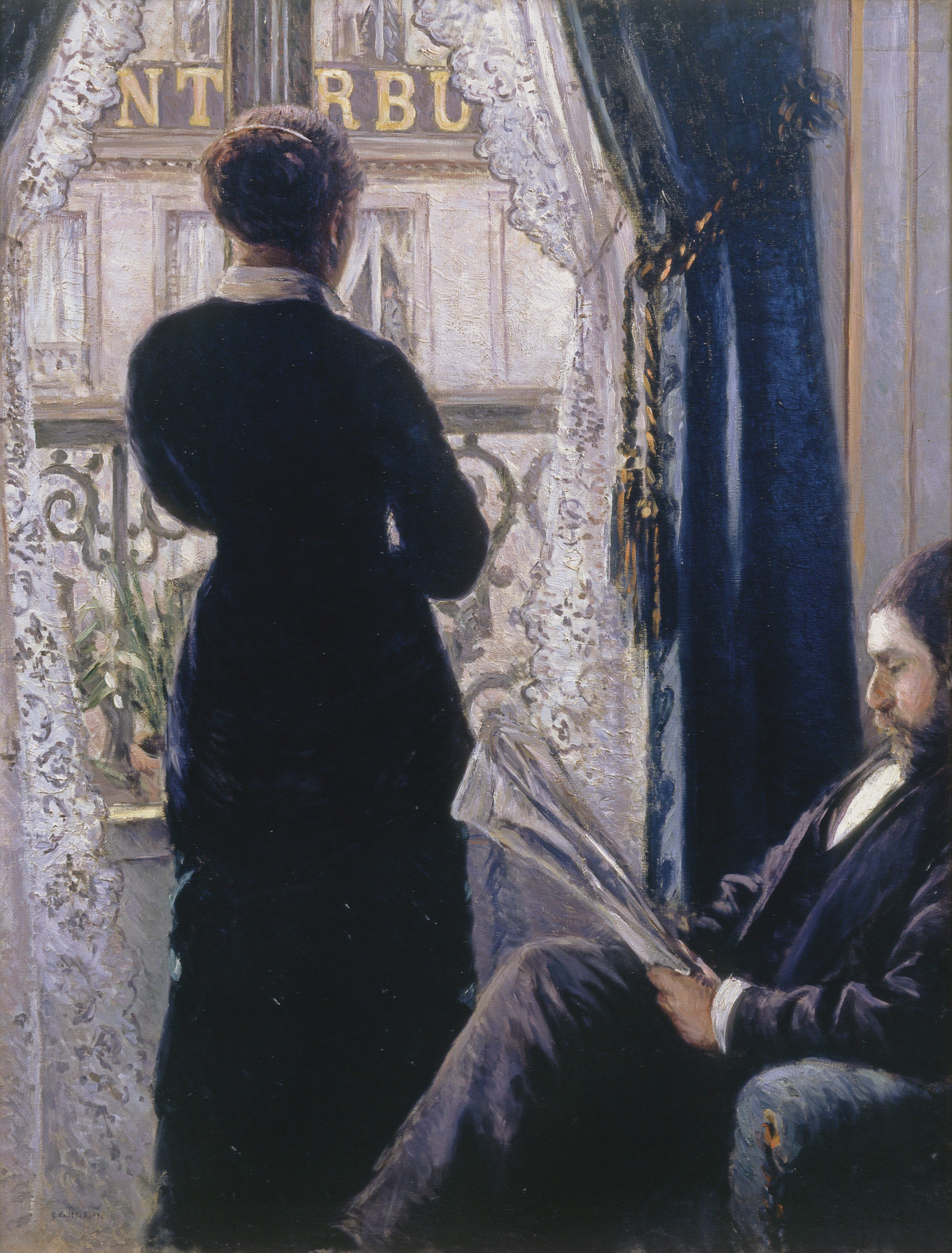
Gustave Caillebotte, Interior, Woman at the Window, 1880. Oil on canvas. Public domain.
Skills We Were Never Taught — Issue 16
Consider the small mercies we perform on the people we date.
The text we do not send, because why start something. The “no, it’s fine, honestly” delivered through a jaw you could crack walnuts on. The reply that gets slower, and slower, until it becomes, with no announcement, silence, which we quietly file under sparing his feelings. The three months of seeing someone while we wait to feel sure, taking the dinners and the weekends and the warmth, running the meter the whole time. We tell ourselves a consistent and rather flattering story about all of it. We are being kind. We do not want to hurt them.
It is worth asking who, exactly, is being spared.
Because most of what passes for kindness in our relationships is not kindness at all. It is discomfort avoidance wearing kindness’s coat, and the gap between the two is the whole of this essay. The unsent text spares us the awkwardness of sending it. The slow fade spares us the ninety unbearable seconds of saying the true thing to someone’s face. The three months of maybe spare us the guilt of being, out loud, the person who disappoints. In nearly every case, the discomfort being avoided is our own, and the person we are so nobly protecting is quietly footing the bill.
§
What honesty is actually for
Strip the sentiment away and honesty in a relationship does one concrete thing. It hands another person an accurate map of the situation they are standing in, so they can decide what to do about it.
That is not a small thing. It is, in fact, the thing. Nobody can meaningfully choose a relationship they only half understand. If your feelings have changed, if you do not want children and they do, if you are not moving towards exclusivity, if you are still half-attached to someone else, if you are quietly furious about something they do every week, then they are making decisions, large ones, about their time and their body and their future, on information you are deliberately keeping from them. Every day you hold the truth back is a day they invest a little more into a picture you already know is not real.
Withholding does not make the truth disappear. It just changes who pays for it, and when. Told now, a hard truth costs you one uncomfortable conversation. Told late, or never, it costs them the months or the years they spent building on ground you knew was hollow, and it bills them at the worst possible moment, when they have the least information and the most to lose. Kindness, if the word is going to mean anything, cannot be the thing that quietly transfers the cost to the person who trusted you.
It helps to rename a few of the phrases we shelter behind, because the language does much of the concealing. Ghosting is not conflict avoidance, it is unilateral ambiguity: one person quietly ending things and leaving the other to work it out unaided. “Keeping my options open” looks rather different from the other side, where it means enjoying someone’s investment while offering none of the clarity back. And “I don’t want to hurt them” is very often the softer story we tell when the thing we truly cannot face is being the person who disappoints. Naming these plainly, if only to ourselves, is where the courage starts.
§
Why it feels like stepping off a cliff
None of this is news to anyone. We know, in principle, that we should say the thing. The reason we so rarely do is that saying it feels genuinely dangerous, and that fear deserves to be taken seriously rather than scolded.
To tell someone you want them is to hand them the power to say they do not want you back. To say you need something is to risk being told you are too much. To name a problem is to risk finding out the relationship cannot survive the naming. There is a whole dating culture built around never being caught wanting anything at all: the studied coolness, the calculated slowness to reply, the small horror of seeming keen. Underneath the pose is something entirely human and a little sad. If I never show that I care, I can never be rejected for caring. Indifference has become a kind of armour, and like all armour it keeps out the very thing you were hoping to let in.
Then there are the stories we absorbed young. A great many of us grew up in houses where directness got punished, or mocked, or met with a slammed door, and learned early that the safest thing to do with a need was to hide it and hope someone noticed. Some of us still carry the oldest romantic superstition going, that if they really loved me, they would simply know, as though love came bundled with telepathy and asking out loud were proof it did not count. Care and knowledge are not the same faculty. You can love someone completely and have no idea what they need, because they have made a lifelong project of never saying.
§
Directness is not the same as brutality
The whole idea gets hijacked right about here, so it needs saying plainly. None of this is a licence for what people proudly call brutal honesty, which is almost always brutality doing an impression of honesty. The person who says the cruellest available thing and then shelters behind “I’m just being honest” is not being brave. They are discharging an emotion and billing it to their partner as feedback.
The part most people miss is that the truth and the way you deliver it are two separate things, and you get to keep the first while completely changing the second. You are not choosing between lying and wounding. You are choosing between a verdict and a conversation.
“You’re exhausting, I can’t deal with you” and “I care about us, and I’m overwhelmed by how fast our fights escalate, I need us to find a slower way to talk” carry roughly the same information. One ends the discussion. The other begins one. The move is the same every time: swap the judgement of their character for the behaviour you actually saw, swap your certainty about their motive for the honest impact it had on you, swap the vague global complaint for one specific request, and swap the verdict about who they are for a conversation about a pattern you both keep landing in. “You never care” becomes “when plans change and you don’t tell me, I feel like an afterthought.” Same courage. None of the collateral damage.
§
What kind honesty actually looks like
If directness is not cruelty, it is also not just using more words. Kind honesty has a shape, and it is roughly four things.
It is clear. It says the actual thing, rather than a riddle the other person has to solve. “I’m not ready for labels” and “do whatever you want” and the immortal “it’s fine” all outsource the real message and leave the other person guessing, usually wrongly. “I don’t want a casual arrangement” is clear. “I care about you, but I’m not developing the feelings I would need to keep dating” is clear. Clarity is what kills false hope, which is the cruellest thing ambiguity quietly manufactures.
It is timely, and this is the one most people get wrong while feeling most considerate. A truth told too late can be a deception even when every word of it is true. Waiting until month six to mention you never wanted children, or accepting someone’s devotion while privately planning your exit, is not honesty delayed. It is a lie made of silence. The rule worth living by is plain: if the information would change what the other person chooses, consents to, or builds their life around, you do not get to sit on it for your own comfort.
It is accountable, which means owning your own experience instead of smuggling an accusation inside it. “You make me insecure” hands them the blame. “I notice I get anxious when I don’t hear from you after we’ve made plans, and a quick message would settle it” owns the feeling and makes it something you can both actually fix.
And it is responsive, which is the part that separates directness from control. Saying your piece and then steamrolling is not honesty, it is a monologue with better vocabulary. It becomes relational the moment you stop and ask: how is that to hear? What do you understand me to be asking for? Is this something you can genuinely give? Directness without that is a well-worded demand. Directness with it is how two people find out whether they can build the thing at all.
Even taking space can be done this way. There is a world between the door that slams and goes quiet for three days, which the last essay in this arc was largely about, and the one that says, “I’m too flooded to do this well right now, I need half an hour, and I’ll come back to it at seven.” The first abandons the conversation. The second protects it. One is withdrawal. The other is directness with the brakes on.
§
The hardest sentences, said kindly
Some moments are hard enough that having the words ready in advance is its own small act of courage. None of these are lines to recite at someone. They are the shape of a sentence that tells the truth without taking a swing.
Ending something early, instead of letting it dissolve into unanswered messages: “I’ve liked getting to know you, and I’m not feeling the connection I would need to keep going, so I would rather say that than leave you guessing. I wish you well.” It costs more than a fade. It costs a great deal less than being the fade on the receiving end.
Asking for what you actually want, instead of hovering in the undefined: “I’ve got to the point where I only want to see one person, and I would like that to be you. If you are not there, I understand, but I will date differently from here.” A clear invitation, a clear consequence, no ultimatum and no games.
Naming a hurt that keeps recurring, instead of quietly adding it to the file: “When I raise something and you go silent for days, I feel shut out rather than worked through. I can live with a pause. I need us to agree when we come back to it.” Behaviour, impact, request, and not one word about their character.
Naming doubt without detonating everything: “I care about you, and I am not ready to promise something long-term while I still have real questions about how we fit. I would rather talk those through honestly than reassure you with something I cannot stand behind.” Hard to say. Kinder than a confidence you do not feel and cannot keep.
§
When the true thing is the dangerous thing
All of this assumes a relationship that is fundamentally safe, and that assumption has to be said out loud, because the advice inverts completely when it does not hold.
If the reason you stay silent is that speaking is dangerous, because of what a partner might do, how they might rage or retaliate or punish or escalate, then “just be direct” is not wise counsel. It is a hazard. In a coercive or controlling or violent relationship, honesty is not owed and confrontation is not brave, it is risky. You do not owe transparency to someone who uses your truths against you, monitors you, isolates you, or makes you afraid. There, the skill is not directness. It is safety, and quiet planning, and support from people equipped to help, first. Nothing in this essay asks anyone to hand a weapon to a person who has already shown they will use it.
And even inside a safe relationship, honesty can be misused, which is worth admitting too. Choosing, mid-fight, the one true thing you know will wound most is not candour, it is aim. Unloading the graphic detail of a betrayal the other person never asked to hear, so that you feel lighter and they feel worse, is not confession, it is a transfer of pain. The honest question before any hard disclosure is not only whether it is true, but who it is for, and what they are meant to do with it once they are holding it.
§
The braver, kinder thing
So the grown-up skill turns out not to be the thing “brutal honesty” advertised. It is not saying everything you think the instant you think it and calling the wreckage integrity. It is finding the courage, and the self-control, to say the things another person genuinely needs to know, in a way that leaves their dignity intact and hands them back their choice.
That is harder than either lying or lashing out, which is probably why so few of us were ever taught it. Avoidance is easy, and cruelty is easy. The thing in the middle, clear and warm and accountable and open to an answer, is a skill, and like every skill this newsletter keeps circling, it can be learned, and practised, and slowly got better at.
The next time you catch yourself composing the unsent text, or softening a no into a maybe, or letting a reply run slower and slower in the name of not hurting someone, there is one question worth putting to yourself underneath all of it. Am I sparing them, or am I sparing myself the discomfort of being honest with them. Because sparing someone the truth is not the same as sparing them. It usually just means they find out later, alone, with more to lose, that the kindest-seeming person in the room was the one who left them holding a map that was never real.
The kinder thing was there the whole time. It only ever asked for a little courage first.
Sharon x
§
The Relational Human is a newsletter about the skills of intimacy. The ones no generation was ever formally taught, and the ones that quietly decide whether our lives, and the lives of those who come after us, feel like genuine connection or its prolonged simulation. Written by Sharon Alexandra: psychotherapist, behaviour specialist, educator, and writer. With rigour, with warmth, and with the conviction that none of this is fixed.
If this found the person who needed it, share it with the one who needs it next.