


Skills We Were Never Taught: Issue 22
Ever caught yourself thinking this? I know they love me, so why do I feel so alone in this?
If you have, you are not being ungrateful, and you are not asking for too much. You are noticing something real, and it is hard to name because the two halves of that sentence seem to cancel each other out. If they love you, how can you be lonely? If you are lonely, how can they love you? So the feeling gets pushed down, or turned on yourself, and you carry on.
They are not cancelling out, because they are measuring different things. Love measures what your partner feels. Loneliness measures what your partner does. You can be loved, sincerely and even deeply, and still be alone in the relationship, because being loved and being in a working partnership are two different things.
§
Love is what you feel towards someone: the warmth, the pull, the wish for their happiness, the ache when they hurt. It can be entirely real and entirely one-directional. A relationship is something else, something built rather than felt, a set of things two people do, over and over, to hold a shared life up. Turning towards each other. Repairing after a rupture. Remembering, planning, carrying, making room. The last essay called these the mechanics, the working parts, and its whole argument was that they, and not the feeling, are what a functioning partnership is made of. Not the glow. The doing.
The feeling and the doing usually travel together, which is why we assume they are one thing. But they can come apart, and when they do, you get a relationship in which the love is real and the structure is being held up by one person. From the inside, it can feel like a partnership, because you are busy doing partnership-shaped things all day long. But a structure that only one person builds and maintains is not a shared structure. It is a solo performance, with an audience of one, who claps warmly and never once picks up a tool.
§
So what does this look like from the inside? Mostly, it looks like being busy. You are the one who notices something is off and raises it. You are the one who initiates the repair after a fight, who plans the time together, who remembers what matters to them, who softens first, who moves towards them across the silence, who carries the emotional weather of two people. You are, in short, running the entire relationship, and because running it keeps you so thoroughly occupied, it can take years to notice that you are running it alone.
They, meanwhile, love you. To be fair to them, they often truly do. They are glad you are there. They enjoy the relationship you are quietly building around them, the way a person enjoys a warm house without ever wondering who is paying to heat it. When you raise a problem, they might even agree, warmly, that you have a point, and then change nothing at all, because agreeing is a feeling and changing is work, and feelings are what they have on offer. What they are not doing is investing. They do not initiate, repair, plan, or carry. They receive. And a relationship in which one person invests and the other receives is not mutual, however much real love is sloshing around inside it.
§
It is worth asking why it is you, of all people, doing all the building, because it is rarely an accident. The people who end up single-handedly running a relationship are very often the ones who learned, a long time ago, that love is something you earn by being useful. An earlier issue traced this back to childhood, to the child who found that closeness arrived when they were helpful, agreeable, easy, and carrying, and who grew into an adult for whom carrying simply is what love feels like. If that is you, a one-sided relationship will not announce itself as an injustice. It will feel familiar, and, worse, it will feel correct, like love done properly, because doing more than your share is the only version of love you were ever shown.
The culture has finally grown some words for the receiving end of all this: the bare minimum, the one-sided relationship, the partner who is present but not really present. They are useful words, and they name something real. But notice that every one of them points outward, at the other person’s failure to give. The harder and more useful thing to look at is inward, at why being treated unfairly felt, for so long, like a problem you could fix by giving even more.
§
This is the cruel engineering of the thing: the love is precisely what keeps you there. If this person were cold, or unkind, or plainly indifferent, you would have gone long ago, because there would be nothing to stay for. But they are not cold. They love you, and you can feel it, and they say it, and it is real. So every time you get close to naming the truth, that you are alone in this, the love rises up as counter-evidence. They love me, you think. How can I complain about someone who loves me? And so you stay, and you carry a little more, on the unspoken theory that if you love each other this much, the investment will surely arrive in the end. That the feeling will, given time and enough effort from you, convert itself into partnership.
It almost never does, and the reason is simple. Your partner is not withholding love. They are giving you all the love they have. What they are withholding is the work, and love and work are not the same currency. You cannot earn a person’s investment by increasing your own. You cannot love someone into becoming a builder. All the extra effort does is prove, to both of you, that the current arrangement functions, because look, it is functioning, you are making certain of it single-handed. The harder you work to hold up your half and theirs, the less reason they will ever have to pick up a tool.
§
None of this means every imbalance is a betrayal, and that has to be said plainly, because relationships are not spreadsheets and no real love runs fifty-fifty week to week. There are seasons when one person simply cannot give much: illness, grief, a new baby, depression, a crisis at work, the flattening years of early parenthood. Carrying your partner through a season like that is not asymmetry. It is love doing precisely what love is for.
The difference between a season and a structure is the difference between temporary and permanent, and between reciprocal and one-directional. A season has an end. The person being carried knows they are being carried, is troubled by it, and carries you in turn when your own hard season comes. A structure has no end, runs one way only, and the person on the receiving end is not troubled in the least, because from where they sit nothing is wrong. That is the tell, and it is worth learning. In a season, the person who can give less is pained by it. In a one-sided structure, they are comfortable. Watch, above everything, for the comfort.
One line needs drawing firmly. This essay is about ordinary, disappointing asymmetry between two people who are fundamentally safe with each other. It is not about coercion, control, or fear. If staying feels dangerous, or if the imbalance is enforced through intimidation rather than simply allowed to drift, that is a different and far more urgent situation, and the task there is safety and support, not a better conversation about who does the dishes. In Australia, 1800RESPECT (1800 737 732) is available at any hour.
§
If you take one thing from this, let it be a change of question. Stop asking whether this person loves you. It is the wrong question, and worse, its usual answer, yes, is the very thing keeping you stuck. Ask instead whether the relationship is mutual. Does the investment run both ways? When you are the one who is low, do they carry you, or do they wait for you to recover so that you can go back to carrying them? When something ruptures, do they ever start the repair, or is that permanently your job? Do they make room for you, or only accept the room you make for them?
Then name it, before you do anything drastic, because it is possible they have simply not noticed. Not an accusation, which only invites defence, but a plain description of the structure: I have been the one holding all of this up, the planning and the repairs and the smoothing-over, and I need that to be shared, not agreed with. Shared. Then watch what happens with great care. A partner capable of mutuality hears that and is troubled by it, and begins, however clumsily, to move. A partner who is not will reassure you, warmly, that you are wonderful and that they will do better, and then hand you back the very same relationship next week. Reassurance, once again, is a feeling. What you are looking for is a change in the doing.
And then, if you want the truest answer there is, there is one experiment, and it takes some nerve. Stop. Stop initiating, stop repairing, stop planning, stop holding up their half of it. Not as a punishment, and not as a game, but simply to see what becomes of the relationship when you are no longer keeping it in the air by yourself. One of two things happens. They feel the absence, register the loss, and begin to take up the work themselves, in which case you have a real relationship that had drifted into a lazy habit, and a habit can be rebuilt. Or the whole thing sinks quietly to the floor, with nobody there to hold it up, and you have your answer, the one the love had been hiding from you all along. A relationship that exists only while you are carrying it was never a relationship. It was a solo, and you were the only one playing.
§
The point was never that your partner does not love you. Perhaps they do, truly and helplessly. The point is that love, on its own, was never going to be enough, because being loved and being met are two different experiences, and you are allowed to want the second one. You are allowed to want a person who does not merely feel warmly about you from the comfort of an armchair, but gets up and builds the thing alongside you, hands dirty, half the weight on their shoulder.
Knowing the difference is what frees you. It is what lets you stop pouring years of yourself into converting a feeling into a partnership it was never going to become on its own. Name the asymmetry, plainly, and then watch what happens when you stop carrying it. Either they rise, and you build something real together for the first time, or they do not, and you are released, at last, to go and find the mutual thing you were always allowed to want. Either way, you stop being alone inside a relationship that has two people in it. And that, whichever way it falls, is not a loss. It is the end of a very long solo, and the first real chance at a duet.
§
What is one thing you carry in your relationship that your partner has never noticed you carrying? Reply to this email or leave it in the comments. I read every one.
Sharon x
If this essay touched on something for you, here are some prompts to guide you to a deeper understanding.
Recognition. Name what you carry.
Example: “I book the holidays, remember the birthdays, and raise every hard conversation. Last month I stopped raising them for a week to see what would happen. Nothing happened.”
Your recognition: What do you carry in this relationship that would simply stop if you stopped? Which of those things did you take on without ever agreeing to?
Reframe. Separate the feeling from the doing.
Example: “I kept saying they love me, so it must be fine. They do love me. What I was missing was someone sharing the work.”
Your reframe: What have you been treating their love as proof of? What is it not proof of?
Practice. Say it once, plainly, then watch the doing.
Example: “I have been holding the planning, the repairs and the smoothing-over, and I need it to be shared, not agreed with.”
Your practice: Write that sentence in your own words. Then write what you would look for over the next month that would count as a change in the doing, not only in the feeling.
§
The Relational Human is a newsletter about the skills of intimacy. The ones no generation was ever formally taught, and the ones that quietly decide whether our lives, and the lives of those who come after us, feel like genuine connection or its prolonged simulation. Written by Sharon Alexandra: psychotherapist, behaviour specialist, educator, and writer. With rigour, with warmth, and with the conviction that none of this is fixed.
If this found the person who needed it, share it with the one who needs it next.
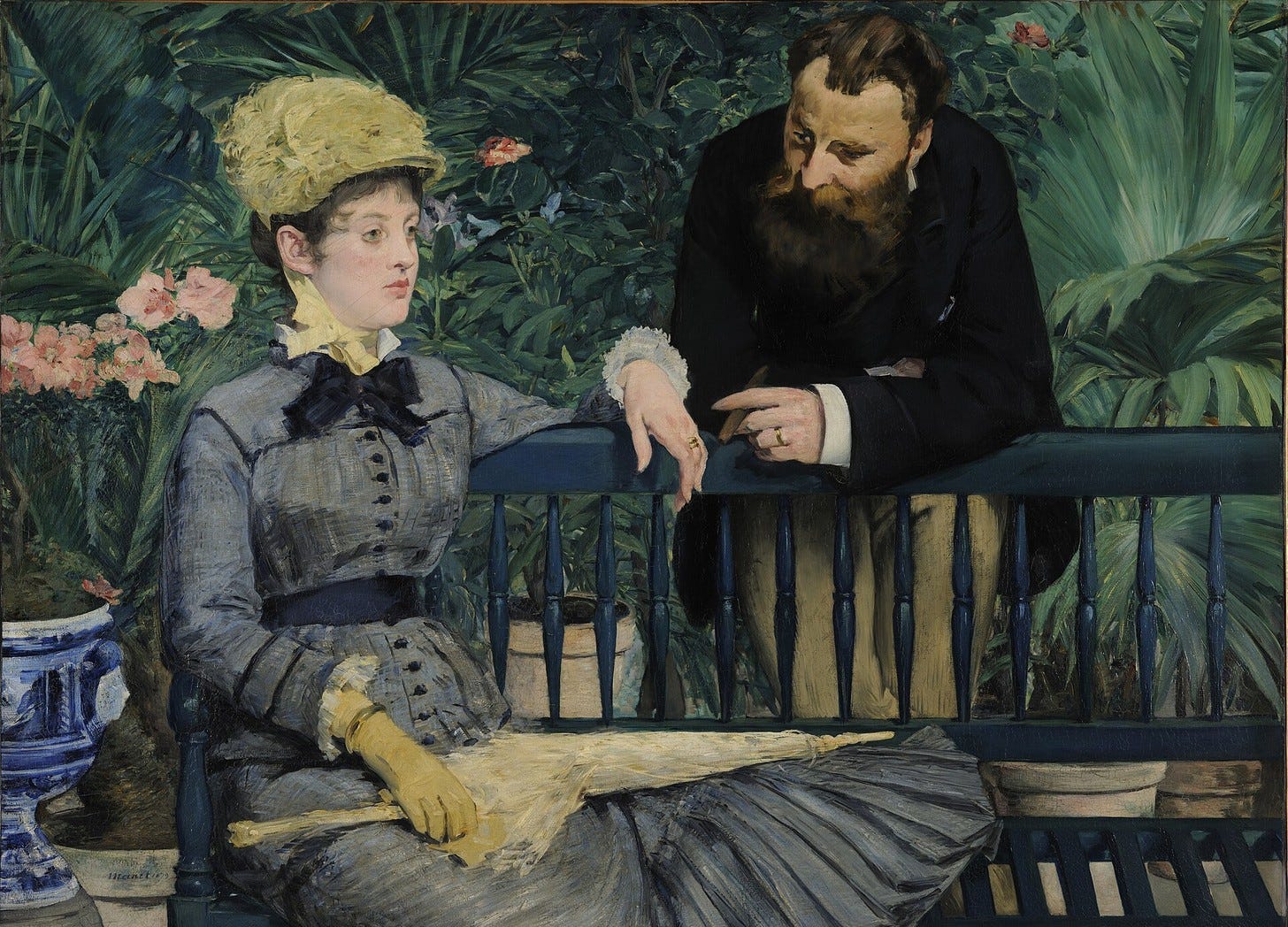
Artwork: Édouard Manet, In the Conservatory, 1878–1879. Oil on canvas. Alte Nationalgalerie, Berlin. Public domain.